English
 Español
 tiếng việt
 русский
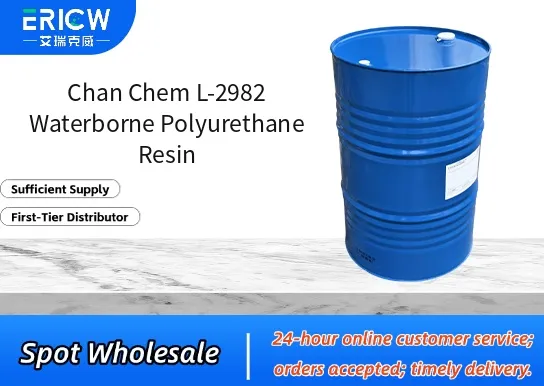
Low-VOC, environmentally compliant formulation meeting global regulatory standards for waterborne coatings.
Excellent film-forming capability with high gloss retention and superior clarity after drying.
Outstanding flexibility and abrasion resistance, ideal for demanding mechanical performance requirements.
Good compatibility with acrylic emulsions and common waterborne additives for formulating versatility.
Stable storage life of ≥12 months at 5–30°C without viscosity drift or phase separation.
High-performance waterborne wood finishes for furniture and flooring.
Leather topcoats requiring soft hand feel, breathability, and scuff resistance.
Plastic substrates coatings, including ABS and PC, for electronics and automotive interiors.
Eco-friendly textile coatings for technical fabrics and functional apparel.
Industrial maintenance coatings for metal substrates where low odor and fast ambient cure are critical.
| Chemical Type | Anionic aliphatic polyurethane dispersion |
| Product Form | Opaque white to light yellow liquid |
| Appearance | Homogeneous, stable dispersion (no sedimentation) |
| Solids Content | 30.0 ± 1.0 wt% |
| pH (at 25°C) | 7.8 – 8.5 |
| Viscosity (DIN4, 25°C) | 150 – 300 mPa·s |
| Particle Size (D50) | ≈60 – 90 nm |
| Minimum Film Formation Temperature (MFFT) | ≈12 – 15°C |
Q1: What are the primary application areas for Chan Chem L-2982?
A: Chan Chem L-2982 is widely used in high-performance waterborne coatings for flexible substrates, including textile finishing, synthetic leather topcoats, and soft-touch automotive interior coatings. Its excellent film-forming ability and low-temperature coalescence make it especially suitable for heat-sensitive materials.
Q2: How does L-2982 compare to solvent-based polyurethane resins in terms of performance and handling?
A: L-2982 delivers comparable mechanical durability, abrasion resistance, and elasticity to many solvent-based systems, while offering significantly lower VOC content and improved workplace safety. It requires no special ventilation or explosion-proof equipment during handling, though formulation pH and shear sensitivity should be monitored during mixing.
Q3: Can L-2982 be blended with other waterborne polymers, such as acrylics or styrene-acrylics?
A: Yes, L-2982 exhibits good compatibility with many common waterborne acrylic and styrene-acrylic dispersions, enabling hybrid formulations that balance cost, flexibility, and surface hardness. Compatibility testing under intended processing conditions—including pH, ionic strength, and shear history—is recommended before full-scale integration.
Q4: What are the key storage and stability considerations for this resin?
A: Store L-2982 in tightly sealed containers at temperatures between 5 °C and 35 °C, away from freezing and direct sunlight. The product typically remains stable for up to 12 months when stored properly. Avoid prolonged exposure to high humidity or contamination with incompatible chemicals, which may induce viscosity drift or phase separation.
Contact With Us:
E-mail: wangxingqiang@ericwchem.com
Have a Questions? Call Us:
Add:
Building A1, Jiete Industrial Park, Huangpu District, Guangzhou City, Guangdong Province, China