English
 Español
 tiếng việt
 русский
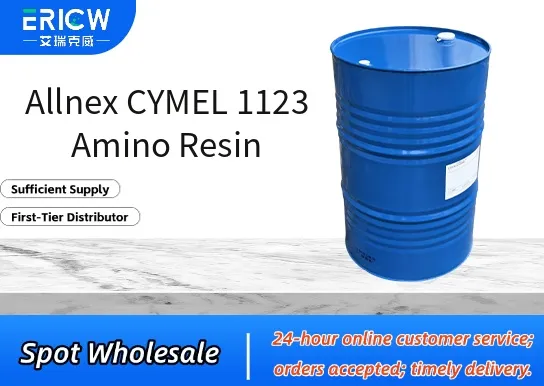
High reactivity with hydroxyl-functional resins, enabling fast cure at low to medium baking temperatures.
Excellent compatibility with acrylic, polyester, and alkyd resin systems.
Low formaldehyde emission profile, supporting compliance with stringent VOC and emissions regulations.
Good storage stability in solvent-based formulations when properly inhibited.
Provides superior hardness, chemical resistance, and gloss retention in cured coatings.
Automotive OEM clearcoats and basecoats.
Industrial coil coatings for metal substrates.
General-purpose appliance finishes.
Can and closure coatings requiring FDA-compliant baked film performance.
High-performance wood furniture and panel coatings.
| Chemical Type | Methylated melamine-formaldehyde resin |
| Product Form | Liquid |
| Appearance | Clear, water-white to pale yellow liquid |
| Solvent Content | ~70–75% (in isobutanol) |
| Non-Volatile Content | 25–27% (by weight, ASTM D1259) |
| Viscosity (25°C) | 100–200 mPa·s (ASTM D4287) |
| pH (10% solution in water) | 7.5–9.0 |
| Key Features | Low-bake reactivity, low formaldehyde release, broad resin compatibility |
Q1: What is the primary function of CYMEL 1123 in coating formulations?
A: CYMEL 1123 functions as a highly reactive melamine-formaldehyde crosslinker, designed to enhance hardness, chemical resistance, and thermal stability in thermosetting coatings—particularly in high-performance industrial and coil coating systems.
Q2: Is CYMEL 1123 compatible with hydroxyl-functional acrylic or polyester resins?
A: Yes, CYMEL 1123 is specifically formulated for compatibility with hydroxyl-terminated resins commonly used in baking enamels. It exhibits good reactivity under standard curing conditions (typically 140–180 °C) without requiring strong acid catalysts in many applications.
Q3: How does CYMEL 1123 compare to other CYMEL® resins in terms of volatility and storage stability?
A: CYMEL 1123 offers improved storage stability compared to highly volatile low-molecular-weight melamines, while maintaining sufficient reactivity for efficient cure. Its balanced volatility supports reduced emissions during application and bake-out without compromising shelf life under recommended storage conditions.
Q4: Can CYMEL 1123 be used in low-bake or ambient-cure systems?
A: CYMEL 1123 is optimized for thermal cure and is not suitable for true ambient-cure applications. While its reactivity may allow partial cure at lower temperatures with appropriate catalysts, full performance development generally requires conventional baking schedules above 130 °C.
Contact With Us:
E-mail: wangxingqiang@ericwchem.com
Have a Questions? Call Us:
Add:
Building A1, Jiete Industrial Park, Huangpu District, Guangzhou City, Guangdong Province, China