English
 Español
 tiếng việt
 русский
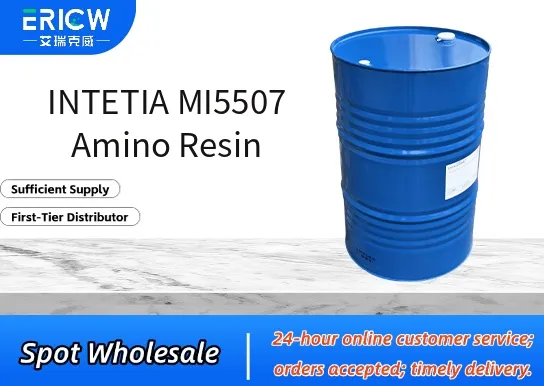
High reactivity with melamine-formaldehyde and phenolic resins for rapid cure kinetics.
Excellent thermal stability and dimensional retention in high-temperature curing processes.
Low formaldehyde emission profile, supporting compliance with stringent environmental regulations.
Superior compatibility with cellulose esters, acrylics, and polyester-based binder systems.
Consistent batch-to-batch performance ensured by controlled molecular weight distribution.
Wood adhesives for particleboard, MDF, and plywood laminating systems.
Coatings for automotive primer surfacers requiring high hardness and chemical resistance.
Industrial baking finishes on metal substrates including appliances and HVAC components.
Electrical laminates in printed circuit board (PCB) base materials.
Foundry core binders offering improved green strength and reduced shakeout emissions.
| Chemical Type | Melamine-modified amino resin |
| Product Form | Clear to pale yellow liquid |
| Appearance | Homogeneous, low-viscosity solution |
| Solvent System | Isopropanol/water blend |
| Non-Volatile Content (wt%) | 60–64% |
| pH (10% aqueous solution) | 7.8–8.4 |
| Viscosity (25°C, mPa·s) | 80–120 |
| Storage Stability | ≥12 months at 5–30°C in sealed container |
Q1: What is the primary function of INTETIA MI5507 in coating formulations?
A: INTETIA MI5507 is a methylated amino resin designed to act as a crosslinking agent for hydroxyl-functional resins—such as alkyds, polyesters, and acrylics—in thermosetting coatings. It enhances cure speed, hardness, chemical resistance, and film integrity under thermal curing conditions.
Q2: Is INTETIA MI5507 compatible with acid-catalyzed systems?
A: Yes, it is commonly used with strong or weak organic acids (e.g., p-toluenesulfonic acid or blocked acid catalysts) to promote efficient crosslinking at moderate bake temperatures. Catalyst selection and dosage should be optimized based on the specific resin system and desired cure profile.
Q3: How should INTETIA MI5507 be stored to maintain stability?
A: Store in tightly sealed original containers in a cool, dry, and well-ventilated area, away from direct sunlight and sources of heat or moisture. Under recommended storage conditions, shelf life is typically 12 months from date of manufacture.
Q4: Can INTETIA MI5507 be used in low-bake or ambient-cure applications?
A: While primarily formulated for thermal cure systems (typically 120–160 °C), modified catalysis and co-resin selection may enable reduced-bake performance. However, full crosslink density and optimal properties are generally achieved under standard thermal cure conditions.
Contact With Us:
E-mail: wangxingqiang@ericwchem.com
Have a Questions? Call Us:
Add:
Building A1, Jiete Industrial Park, Huangpu District, Guangzhou City, Guangdong Province, China