English
 Español
 tiếng việt
 русский
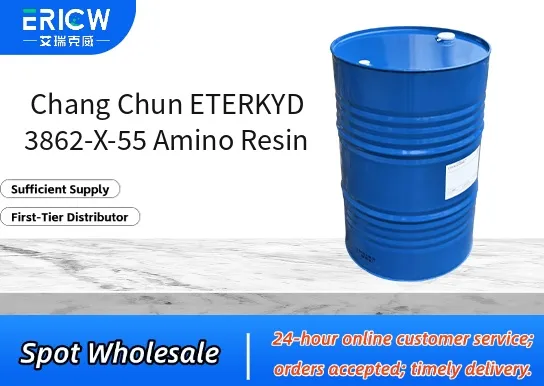
High reactivity with hydroxyl-functional resins for fast cure at low to medium baking temperatures.
Excellent compatibility with acrylic, polyester, and alkyd resin systems.
Superior gloss retention and color stability after curing under thermal stress.
Low formaldehyde emission profile meeting stringent environmental compliance requirements.
Good storage stability in solvent-based formulations without premature gelation.
Automotive OEM topcoats and refinish coatings.
Industrial coil coatings for pre-painted metal substrates.
Appliance finishes requiring high durability and aesthetic performance.
General-purpose can coatings for food and beverage packaging.
High-gloss wood furniture and panel coatings.
| Chemical Type | Methylated melamine-formaldehyde resin |
| Product Form | Liquid |
| Appearance | Clear, pale yellow to amber liquid |
| Solvent Content | Approx. 60–65% (by weight) in aromatic hydrocarbon solvent |
| Non-Volatile Content | 35–40% (by weight) |
| Viscosity (25°C) | 100–250 mPa·s (Brookfield RV, Spindle #1) |
| Acid Number | ≤ 5 mg KOH/g |
| Storage Stability | ≥ 6 months at 20–25°C in sealed container |
Q1: What is the primary function of ETERKYD 3862-X-55 in coating formulations?
A: ETERKYD 3862-X-55 serves as a crosslinking agent for hydroxyl-functional resins—particularly alkyds and acrylic polyols—in thermosetting coatings. It enhances cure speed, hardness, chemical resistance, and film durability under thermal curing conditions.
Q2: Is ETERKYD 3862-X-55 compatible with high-solids or low-VOC coating systems?
A: Yes—it is formulated to support modern low-VOC and high-solids applications. Its reactivity profile and solubility characteristics allow effective integration into solvent-borne systems with reduced aromatic content, and it can be adapted for use in certain hybrid water-reducible formulations when properly stabilized.
Q3: What is the recommended curing temperature range for optimal performance?
A: Optimal cure is typically achieved between 120 °C and 160 °C, depending on substrate, film thickness, and catalyst selection. It exhibits good reactivity at mid-range temperatures, making it suitable for industrial coil and appliance coating lines where balanced throughput and performance are required.
Q4: How should ETERKYD 3862-X-55 be stored to maintain stability?
A: Store in tightly sealed original containers in a cool, dry, and well-ventilated area below 30 °C. Avoid prolonged exposure to moisture, humidity, or elevated temperatures, as amino resins may undergo premature condensation or viscosity increase over time under adverse conditions.
Q5: Can this resin be used without an acid catalyst?
A: While it exhibits some inherent reactivity, optimal cure kinetics and film properties are generally achieved with a conventional acid catalyst—such as p-toluenesulfonic acid (p-TSA) or blocked sulfonic acids. Uncatalyzed use may result in incomplete crosslinking and compromised performance, especially at lower cure temperatures.
Contact With Us:
E-mail: wangxingqiang@ericwchem.com
Have a Questions? Call Us:
Add:
Building A1, Jiete Industrial Park, Huangpu District, Guangzhou City, Guangdong Province, China