English
 Español
 tiếng việt
 русский
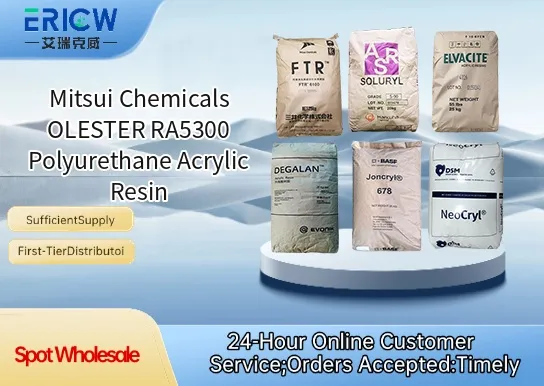
Hybrid polymer architecture combining polyurethane toughness with acrylic weatherability and clarity.
Excellent flexibility and impact resistance at low temperatures without sacrificing hardness.
Superior adhesion to diverse substrates including plastics, metals, and coated surfaces.
Low-VOC formulation compliant with modern environmental regulations for industrial coatings.
Good compatibility with common crosslinkers (e.g., melamine, isocyanate, and carbodiimide types).
Automotive clearcoats and basecoat/clearcoat systems for OEM and refinish applications.
High-performance industrial maintenance coatings for machinery and equipment.
Plastic coatings for exterior automotive parts such as grilles, trim, and mirror housings.
Premium architectural metal coatings requiring long-term gloss retention and UV stability.
Functional topcoats for electronic enclosures and consumer appliance housings.
| Chemical Type | Polyurethane-acrylic hybrid resin |
| Product Form | Liquid, solvent-based solution |
| Appearance | Clear to pale yellow transparent liquid |
| Solvent System | Toluene/xylene/ester blend (typical) |
| Solids Content (wt%) | 55–60% (as supplied) |
| Viscosity (25°C, mPa·s) | 1,200–2,500 (Brookfield RV, spindle #3, 20 rpm) |
| Acid Value (mg KOH/g) | 8–12 |
| Hydroxyl Value (mg KOH/g) | 45–55 |
Q1: What is the primary function of OLESTER RA5300 in coating formulations?
A: OLESTER RA5300 functions as a reactive polyurethane-acrylic hybrid resin designed to enhance scratch resistance, mar resistance, and surface hardness in clear and pigmented solvent-borne and high-solids coatings—particularly for automotive refinish, industrial wood, and plastic substrates.
Q2: Is OLESTER RA5300 compatible with common crosslinkers used in industrial coatings?
A: Yes, OLESTER RA5300 is formulated to be compatible with standard amino resins (e.g., melamine-formaldehyde) and isocyanate-based crosslinkers, enabling flexible curing options including ambient, forced-dry, or thermal bake systems depending on formulation design.
Q3: How does OLESTER RA5300 differ from conventional acrylic or polyurethane resins?
A: Unlike traditional acrylics or PU resins, OLESTER RA5300 integrates both acrylic backbone rigidity and urethane segment flexibility into a single macromolecular structure—delivering a balanced profile of hardness, flexibility, and chemical resistance without requiring separate resin blending.
Q4: What solvents are recommended for diluting OLESTER RA5300?
A: It is typically soluble and stable in common organic solvents such as xylene, toluene, ethyl acetate, and ketones (e.g., MEK, MIBK); compatibility with specific solvent blends should be verified experimentally due to formulation-dependent viscosity and stability requirements.
Q5: Can OLESTER RA5300 be used in low-VOC or high-solids coating systems?
A: Yes, its molecular architecture supports formulation in medium- to high-solids systems (typically above 60% NV), helping formulators reduce overall VOC content while maintaining film integrity and performance attributes.
Contact With Us:
E-mail: wangxingqiang@ericwchem.com
Have a Questions? Call Us:
Add:
Building A1, Jiete Industrial Park, Huangpu District, Guangzhou City, Guangdong Province, China