English
 Español
 tiếng việt
 русский
High thermal stability enabling reliable operation at elevated temperatures up to 600 °C.
Exceptional resistance to sintering and chemical deactivation in sulfur-containing exhaust streams.
Precisely engineered platinum–palladium active phase for superior low-temperature oxidation activity.
Optimized washcoat adhesion and mechanical robustness for long service life under cyclic thermal stress.
Low pressure drop design suitable for integration into compact catalytic converter systems.
Automotive diesel oxidation catalysts (DOC) for light- and heavy-duty vehicles.
Off-road engine aftertreatment systems including construction and agricultural machinery.
Stationary diesel generator exhaust treatment for power generation applications.
Marine auxiliary engine emission control complying with IMO Tier II/III requirements.
Industrial gas turbine exhaust abatement for volatile organic compound (VOC) and CO oxidation.
| Chemical Type | Platinum–palladium on ceria–zirconia mixed oxide support |
| Product Form | Monolithic ceramic honeycomb substrate (cordierite or silicon carbide) |
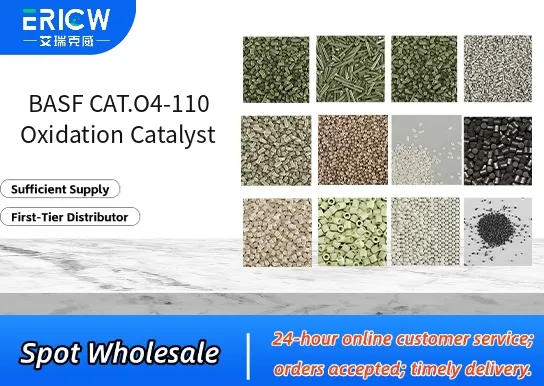
| Appearance | Gray-black structured monolith with uniform washcoat distribution |
| Primary Applications | Diesel oxidation catalysis (CO, HC, and soluble organic fraction oxidation) |
| Key Features | High oxygen storage capacity, sulfur tolerance, and hydrothermal stability |
| Benefits | Extended catalyst lifetime, reduced light-off temperature, and compliance with Euro VI / EPA 2010+ standards |
| Standard Cell Density | 200–400 cpsi (cells per square inch) |
| Operating Temperature Range | 150–600 °C (continuous), peak up to 750 °C (short-term) |
Q1: What is the primary function of BASF CAT.O4-110 in industrial oxidation processes?
A: BASF CAT.O4-110 is a heterogeneous oxidation catalyst designed to selectively promote aerobic oxidation reactions—particularly for converting organic intermediates such as alcohols, aldehydes, or hydrocarbons—under mild thermal conditions. It enhances reaction efficiency and selectivity while minimizing unwanted side products.
Q2: Is CAT.O4-110 suitable for liquid-phase or gas-phase applications?
A: CAT.O4-110 is primarily formulated for fixed-bed or slurry-phase liquid-phase oxidation processes, where it demonstrates robust stability and consistent activity. While not optimized for high-velocity gas-phase systems, it may be evaluated for specific vapor-phase applications under controlled temperature and residence time conditions.
Q3: How does CAT.O4-110 compare to traditional cobalt- or manganese-based catalysts in terms of environmental profile?
A: CAT.O4-110 is engineered with reduced heavy-metal content and avoids intentionally added cobalt, chromium, or lead compounds. Its formulation supports lower metal leaching potential and simplifies end-of-life handling compared to legacy transition-metal catalysts—aligning with evolving industry expectations for sustainable process intensification.
Q4: What are key handling and storage recommendations for maintaining catalyst performance?
A: Store CAT.O4-110 in its original sealed packaging under dry, ambient conditions, away from strong oxidizers, reducing agents, and excessive humidity. Avoid prolonged exposure to air prior to use, as surface moisture absorption may affect initial activation behavior. Pre-treatment (e.g., controlled thermal conditioning) is typically recommended before first use in process streams.
Contact With Us:
E-mail: wangxingqiang@ericwchem.com
Have a Questions? Call Us:
Add:
Building A1, Jiete Industrial Park, Huangpu District, Guangzhou City, Guangdong Province, China