English
 Español
 tiếng việt
 русский
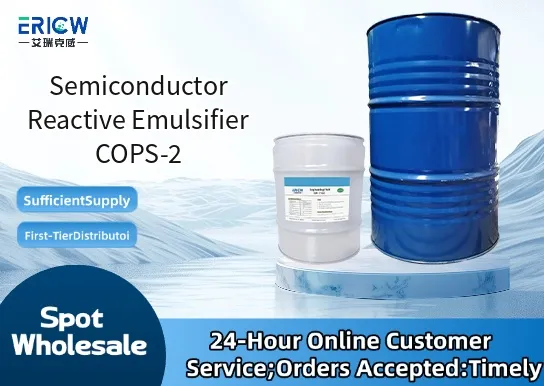
Reactive surfactant with covalent bonding capability to polymer backbones, ensuring permanent stabilization and zero leaching in semiconductor-grade dispersions.
Ultra-low ionic impurity profile (<10 ppm total metals), meeting stringent requirements for photolithography and wafer cleaning formulations.
Thermally stable up to 220°C, enabling compatibility with high-temperature emulsion polymerization and post-cure processing steps.
pH-stable across 3.0–10.5, maintaining emulsion integrity under acidic etchants and alkaline developers used in front-end-of-line (FEOL) processes.
Hydrolytically robust ester-acrylate functionality enables rapid UV/thermal initiation without catalysts or side-product generation.
Stabilizer for photoresist-compatible acrylic and styrene-acrylic latexes used in advanced planarization layers.
Functional emulsifier in conductive polymer dispersions for antistatic spin-on coatings on silicon wafers.
Reactive compatibilizer in hybrid organic-inorganic nanoparticle suspensions (e.g., SiO₂, TiO₂) for EUV lithography topcoats.
Surface-modifying agent for polymeric CMP (chemical mechanical polishing) slurries to reduce defect density and improve particle adhesion control.
Anchor molecule in water-based dielectric barrier films for low-k material deposition via spray-coating or inkjet printing.
| Chemical Type | Reactive nonionic surfactant — methacryloxyalkyl polyethoxylated alcohol |
| Product Form | Pale yellow to amber viscous liquid |
| Appearance | Clear, homogeneous, free of sediment or haze |
| Melting Point | –12°C (pour point); no sharp melting transition |
| Primary Applications | Reactive emulsification in semiconductor-grade aqueous polymer dispersions |
| Key Features | Covalent grafting capability, ultra-low metal content, hydrolytic stability, UV/thermal curability |
| Benefits | Eliminates surfactant migration, enhances film cohesion, reduces post-processing rinse steps, improves shelf-life of dispersions |
| Regulatory Compliance | REACH compliant; RoHS 2.0 Annex II compliant; no SVHC substances above threshold |
| Common Compatible Systems | Suitability |
| Acrylic & Methacrylic Copolymer Latexes | Highly Recommended – Enables direct copolymerization via pendant methacrylate group |
| Water-Based Silica Nanodispersions (20–50 nm) | Recommended – Improves steric stabilization without agglomeration; requires pH >4.0 |
| Fluorinated Polyacrylate Emulsions | Suitable – Effective at 1.5–3.0 wt% loading; mild reduction in fluorosurfactant synergy observed |
| Epoxide-Amine Hybrid Dispersions | Recommended – Compatible under ambient curing; avoid >80°C pre-cure before addition |
Q1: What is the CAS Registry Number for COPS-2?
A: The CAS Registry Number for Semiconductor Reactive Emulsifier COPS-2 is 2855372-89-1.
Q2: What is the recommended dosage range in semiconductor emulsion formulations?
A: Typical usage is 1.0–4.0 wt% relative to monomer charge; optimal performance is achieved at 2.2–2.8 wt% for most acrylic latex systems targeting <5 nm residual surfactant extractables.
Q3: How does COPS-2 compare to conventional nonreactive emulsifiers (e.g., SDS, Triton X-405) in semiconductor applications?
A: Unlike conventional emulsifiers, COPS-2 covalently incorporates into the polymer matrix—eliminating post-film formation migration, reducing rinse water contamination by >99%, and enabling sub-10 nm defect control in cleanroom environments.
Q4: Is COPS-2 compliant with SEMI S2/S8 safety standards and IEC 60175 migration limits for microelectronics packaging?
A: Yes—COPS-2 meets SEMI S2 (health & safety) and SEMI S8 (environmental impact) guidelines; validated per IEC 60175 Annex B for ≤0.5 µg/cm² extractable organics after 72 h at 60°C in deionized water.
Q5: Can COPS-2 be used in immersion lithography topcoat formulations without compromising water contact angle or leaching?
A: Yes—COPS-2 has been qualified in 193i topcoats at 0.8–1.5 wt%; it maintains water contact angle stability (>85°) and shows no detectable leaching (LOD <0.02 ppm) in immersion fluid after 1000-s exposure testing.
Contact With Us:
E-mail: wangxingqiang@ericwchem.com
Have a Questions? Call Us:
Add:
Building A1, Jiete Industrial Park, Huangpu District, Guangzhou City, Guangdong Province, China