English
 Español
 tiếng việt
 русский
High-gloss, excellent flow and leveling for premium surface aesthetics.
Outstanding weather resistance and UV stability for long-term outdoor performance.
Good chemical resistance to solvents, acids, and alkalis in cured powder coatings.
Optimized reactivity for efficient curing at standard industrial bake schedules (e.g., 200 °C/15 min).
Low melt viscosity enabling smooth film formation and reduced orange peel effect.
Architectural aluminum extrusions (curtain walls, windows, façades).
Automotive exterior trim and non-under-hood components.
Outdoor furniture and garden equipment.
Street lighting fixtures and traffic signage substrates.
Industrial metal enclosures exposed to harsh environmental conditions.
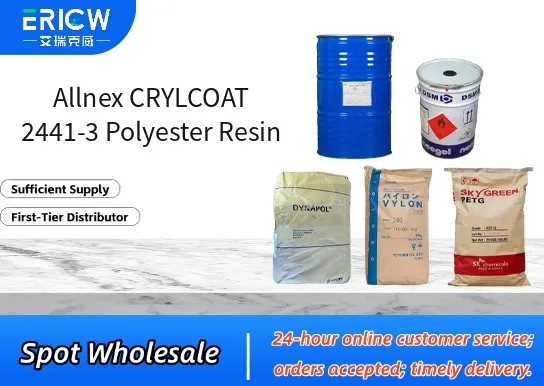
| Chemical Type | Carboxyl-functional saturated polyester |
| Product Form | Pale yellow to light amber solid granules |
| Appearance | Free-flowing granular solid |
| Acid Value (mg KOH/g) | 26–30 |
| Gardner Color (on 50% w/w solution in MEK) | ≤ 3 |
| Melt Viscosity (at 180 °C, Pa·s) | 2,500–3,500 |
| Softening Point (°C, Ring & Ball) | 78–84 |
| Primary Applications | Standard TGIC-free and HAA-cured architectural and industrial powder coatings |
Q1: What is the primary application of CRYLCOAT 2441-3 in powder coating systems?
A: CRYLCOAT 2441-3 is a carboxyl-functional polyester resin specifically designed for use in TGIC-free, high-gloss, exterior-grade thermosetting powder coatings—particularly where excellent weather resistance, gloss retention, and mechanical durability are required.
Q2: Which curing agents is CRYLCOAT 2441-3 typically compatible with?
A: It is formulated to react efficiently with standard epoxy-functional hardeners such as glycidyl ester or triglycidyl isocyanurate (TGIC-free) crosslinkers, enabling robust cure profiles across conventional and low-bake powder coating processes.
Q3: How does CRYLCOAT 2441-3 support sustainability goals in powder coating formulations?
A: As a TGIC-free resin, it supports safer handling and regulatory compliance in regions restricting hazardous crosslinkers. Its optimized reactivity also contributes to energy-efficient curing, including potential compatibility with reduced-temperature bake schedules without compromising film performance.
Q4: What are the key handling and storage recommendations for this resin?
A: Store in a cool, dry place away from direct sunlight and moisture. Keep containers tightly sealed when not in use. Avoid prolonged exposure to elevated temperatures prior to processing, as premature thermal aging may affect flow and cure behavior.
Contact With Us:
E-mail: wangxingqiang@ericwchem.com
Have a Questions? Call Us:
Add:
Building A1, Jiete Industrial Park, Huangpu District, Guangzhou City, Guangdong Province, China