English
 Español
 tiếng việt
 русский
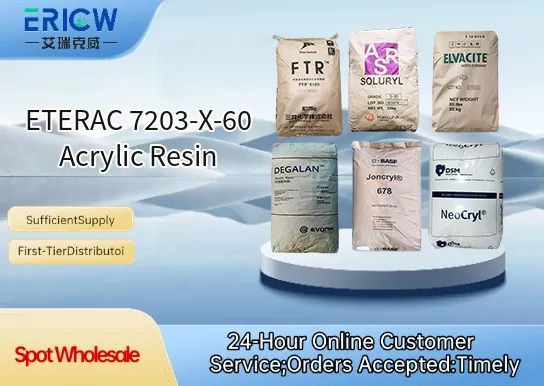
High solids content for reduced VOC emissions and improved coating efficiency.
Excellent UV resistance and long-term color stability in outdoor applications.
Good compatibility with common crosslinkers including melamine and polyisocyanates.
Low viscosity at high solids, enabling easy handling and spray application.
Superior gloss retention and surface hardness after curing.
Automotive OEM and refinish topcoats.
Industrial maintenance coatings for metal substrates.
Architectural pre-coated metal (coil coating) systems.
High-performance plastic coatings for automotive trim and electronics housings.
General-purpose durable decorative finishes requiring weatherability.
| Chemical Type | Thermosetting acrylic copolymer |
| Product Form | Liquid resin solution |
| Appearance | Clear to pale yellow, homogeneous liquid |
| Solids Content (wt%) | 60 ± 1% |
| Viscosity (mPa·s, 25°C, Brookfield RVT, #3 spindle, 20 rpm) | 4,500 – 6,500 |
| Acid Value (mg KOH/g) | 8 – 12 |
| Glass Transition Temperature (Tg, °C, DSC) | 72 – 76 |
| Primary Solvent System | Aromatic hydrocarbons / ester blend |
Q1: What is the primary function of ETERAC 7203-X-60 in coating formulations?
A: ETERAC 7203-X-60 is a reactive acrylic resin designed to enhance crosslink density, improve film hardness, and increase chemical resistance in thermosetting coating systems—particularly where high-gloss retention and long-term durability are required.
Q2: Which curing agents is ETERAC 7203-X-60 typically compatible with?
A: It is formulated for compatibility with common amino resins (e.g., melamine-formaldehyde types) and can also be used with polyisocyanates in dual-cure systems. Compatibility should always be verified through small-scale formulation testing under intended cure conditions.
Q3: How does ETERAC 7203-X-60 affect viscosity and application properties in liquid coatings?
A: As a medium-to-high molecular weight acrylic resin, it contributes moderate viscosity and good flow characteristics when properly dissolved in standard aromatic or ester solvents. Its rheological profile supports spray and coil coating applications without excessive sagging or leveling issues.
Q4: Is ETERAC 7203-X-60 suitable for low-VOC or high-solids coating systems?
A: Yes—it is commonly incorporated into high-solids acrylic-aminoplast systems and can be adapted for solvent-reduced formulations. Its reactivity and film-forming efficiency help maintain performance while supporting VOC reduction strategies.
Contact With Us:
E-mail: wangxingqiang@ericwchem.com
Have a Questions? Call Us:
Add:
Building A1, Jiete Industrial Park, Huangpu District, Guangzhou City, Guangdong Province, China