English
 Español
 tiếng việt
 русский
Excellent clarity and UV resistance for long-term outdoor durability.
Good thermal stability with processing temperature range of 160–200 °C.
High compatibility with common plasticizers, PVC, and other thermoplastics.
Low melt viscosity enabling easy extrusion, injection molding, and coating application.
Non-yellowing performance under accelerated aging and natural weathering conditions.
Automotive interior trim and exterior decorative components.
Transparent protective coatings for signage and display panels.
Blends with PVC for rigid transparent profiles and sheets.
Injection-molded optical parts requiring high gloss and dimensional stability.
Extruded acrylic films for laminating and surface protection layers.
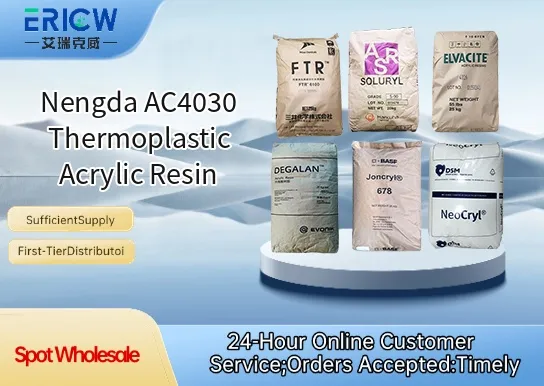
| Chemical Type | Thermoplastic acrylic copolymer |
| Product Form | Pellets |
| Appearance | Translucent white granules |
| Primary Applications | Transparent thermoplastic blends, protective coatings, extruded films |
| Key Features | Clarity, UV resistance, thermal processability, non-yellowing |
| Benefits | Enhanced weatherability, ease of processing, compatibility with PVC and plasticizers |
| Density (g/cm³) | 1.18–1.22 |
| Melt Flow Rate (230 °C/3.8 kg, g/10 min) | 5–12 |
Q1: What are the primary application areas for Nengda AC4030?
A: Nengda AC4030 is widely used in high-gloss thermoplastic coatings for automotive trim, electronics housings, and consumer appliances. It is also employed as a rheology modifier and surface enhancer in solvent-based and high-solids industrial coatings where clarity, hardness, and rapid film formation are required.
Q2: How does AC4030 differ from thermosetting acrylic resins?
A: Unlike thermosetting acrylics, AC4030 is fully thermoplastic—meaning it softens upon heating and re-solidifies upon cooling without chemical crosslinking. This enables excellent solubility in common organic solvents, recyclability of overspray, and compatibility with thermoplastic substrates such as ABS and PC without risk of thermal degradation during processing.
Q3: Is AC4030 suitable for food-contact coatings?
A: While AC4030 itself is not inherently restricted for food-contact use, its suitability depends entirely on the full formulation—including solvents, crosslinkers, and additives—as well as compliance with applicable regional regulatory frameworks. Formulators must conduct full migration and safety assessments when targeting food-contact applications.
Q4: What solvents are recommended for dissolving AC4030?
A: AC4030 exhibits good solubility in aromatic hydrocarbons (e.g., xylene, toluene), ketones (e.g., MEK, MIBK), and esters (e.g., ethyl acetate, butyl acetate). It has limited solubility in alcohols and aliphatic hydrocarbons, and is generally incompatible with water and glycol ethers.
Contact With Us:
E-mail: wangxingqiang@ericwchem.com
Have a Questions? Call Us:
Add:
Building A1, Jiete Industrial Park, Huangpu District, Guangzhou City, Guangdong Province, China