English
 Español
 tiếng việt
 русский
Excellent film-forming capability with high clarity and gloss retention.
Superior abrasion and scratch resistance for demanding end-use environments.
Low VOC content (< 50 g/L), compliant with stringent global environmental regulations.
Good compatibility with acrylics, cellulose derivatives, and common waterborne additives.
Stable storage life of ≥12 months at 5–30°C without viscosity drift or phase separation.
Waterborne wood coatings for furniture, flooring, and cabinetry.
Leather finishing topcoats requiring flexibility and hydrolytic stability.
Industrial plastic coatings for electronics housings and automotive interior trim.
Textile and nonwoven fabric coatings for enhanced durability and hand feel.
Overprint varnishes for flexible packaging films and paperboard.
| Chemical Type | Aliphatic waterborne polyurethane dispersion |
| Product Form | Opaque white to slightly bluish liquid |
| Appearance | Homogeneous dispersion, free of gel or sediment |
| Solids Content (wt%) | 30.0 ± 1.0% |
| pH Value | 8.0 – 8.8 |
| Viscosity (mPa·s, 25°C, Brookfield RVT, spindle #3, 20 rpm) | 150 – 400 |
| Density (g/cm³, 25°C) | 1.01 – 1.03 |
| Particle Size (D50, nm) | 80 – 120 |
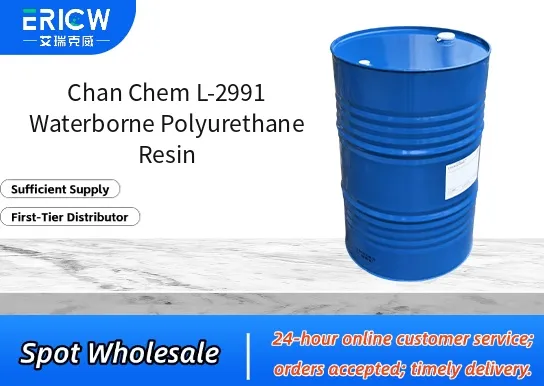
Q1: What are the primary application areas for Chan Chem L-2991?
A: Chan Chem L-2991 is widely used in high-performance waterborne coatings for flexible substrates, including synthetic leather finishing, textile coatings, and soft-touch automotive interior trim. Its excellent film flexibility, abrasion resistance, and low-temperature performance make it especially suitable for applications requiring dynamic mechanical durability.
Q2: Can L-2991 be blended with other waterborne resins or additives?
A: Yes, L-2991 demonstrates good compatibility with common waterborne acrylics, polyurethane dispersions, and crosslinkers such as aziridine or carbodiimide types. However, compatibility should always be verified through small-scale formulation trials due to sensitivity to pH, ionic strength, and surfactant systems.
Q3: How does L-2991 perform in terms of drying speed and film formation under ambient conditions?
A: L-2991 forms continuous, coalesced films at room temperature without requiring forced drying, though optimal film integrity and mechanical development typically benefit from mild thermal curing (e.g., 60–80 °C for 10–30 minutes). Drying time is influenced by film thickness, humidity, and substrate porosity.
Q4: Is L-2991 suitable for formulations targeting low-VOC or zero-NMP compliance?
A: Yes — as a true waterborne polyurethane dispersion, L-2991 contains no organic solvents, NMP, or APEO-based surfactants. It supports formulators in meeting stringent global VOC regulations and sustainability targets without compromising film performance.
Contact With Us:
E-mail: wangxingqiang@ericwchem.com
Have a Questions? Call Us:
Add:
Building A1, Jiete Industrial Park, Huangpu District, Guangzhou City, Guangdong Province, China