English
 Español
 tiếng việt
 русский
High reactivity with melamine-formaldehyde and urea-formaldehyde resins for rapid cure kinetics.
Excellent compatibility with alkyd, polyester, and acrylic binder systems in thermosetting coatings.
Low free formaldehyde content, supporting compliance with stringent VOC and emissions regulations.
Superior crosslink density yielding enhanced hardness, chemical resistance, and gloss retention.
Consistent batch-to-batch performance due to tightly controlled synthesis and purification processes.
Automotive OEM and refinish topcoats requiring high durability and rapid oven cure.
Industrial coil coatings for metal roofing, cladding, and appliance panels.
Can coatings for food and beverage containers, including interior and exterior lacquers.
General-purpose baking enamels for metal furniture, heating appliances, and agricultural equipment.
Electrophoretic deposition (EDP) primer co-solids and post-treatment crosslinkers.
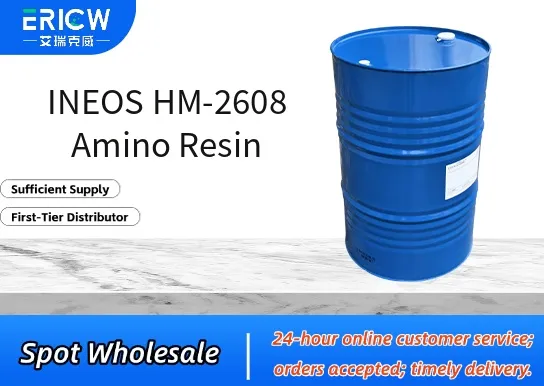
| Chemical Type | Melamine-formaldehyde modified amino resin |
| Product Form | Clear to pale yellow liquid |
| Appearance | Homogeneous, low-viscosity solution |
| Primary Applications | Crosslinker for thermosetting solvent-borne and high-solids coatings |
| Key Features | Low free formaldehyde, high reactivity, excellent storage stability |
| Benefits | Improved throughput, reduced energy consumption, enhanced film integrity |
| Typical Solvent System | Isobutanol / n-butanol blend (standard grade) |
| Storage Stability | ≥12 months at 20–25°C in sealed container |
Q1: What is the primary function of INEOS HM-2608 in coating formulations?
A: INEOS HM-2608 is a melamine-formaldehyde based amino resin designed to act as a crosslinking agent, enhancing hardness, chemical resistance, and thermal stability in thermosetting coatings—particularly for metal decorating, coil coating, and industrial finishes.
Q2: Is HM-2608 compatible with common hydroxyl-functional resins such as acrylics or polyesters?
A: Yes, HM-2608 is formulated for compatibility with standard hydroxyl-containing resins, including polyester, acrylic, and alkyd systems. It typically cures efficiently under conventional baking conditions (e.g., 140–180 °C), though optimal cure profiles should be validated within the specific formulation.
Q3: How does HM-2608 compare to other melamine resins in terms of reactivity and storage stability?
A: HM-2608 offers balanced reactivity—moderately faster than highly etherified low-reactivity melamines, yet more stable in storage than highly reactive, partially methylolated types. Its formulation supports good shelf life under recommended cool, dry storage conditions without premature gelation.
Q4: Can HM-2608 be used in low-VOC or formaldehyde-emission-sensitive applications?
A: HM-2608 is a fully alkylated melamine resin with inherently low free formaldehyde content. While it contributes minimal volatile emissions during cure, final compliance with VOC or formaldehyde release requirements depends on the full formulation, application method, and curing efficiency—and should be confirmed through end-product testing.
Contact With Us:
E-mail: wangxingqiang@ericwchem.com
Have a Questions? Call Us:
Add:
Building A1, Jiete Industrial Park, Huangpu District, Guangzhou City, Guangdong Province, China