English
 Español
 tiếng việt
 русский
Enhanced pot life compared to standard cycloaliphatic amines, enabling extended processing window for large-scale casting and laminating.
Improved hydrolytic stability, reducing sensitivity to ambient moisture during handling and storage.
Low volatility and negligible amine odor, supporting safer workplace environments and compliance with industrial hygiene standards.
Optimized reactivity balance—faster than aromatic amines yet controllable at room temperature for reliable gel time predictability.
Excellent compatibility with bisphenol-A and novolac epoxy resins, yielding high glass transition temperature (Tg) and mechanical integrity in cured networks.
High-performance electrical encapsulants for power electronics and LED modules.
Structural adhesives requiring rapid development of cohesive strength and low-temperature cure capability.
Wind turbine blade bonding and composite repair systems demanding thermal resilience and fatigue resistance.
Industrial flooring and grouting compounds where chemical resistance and low exotherm are critical.
Aerospace interior components requiring low smoke density and halogen-free formulation compatibility.
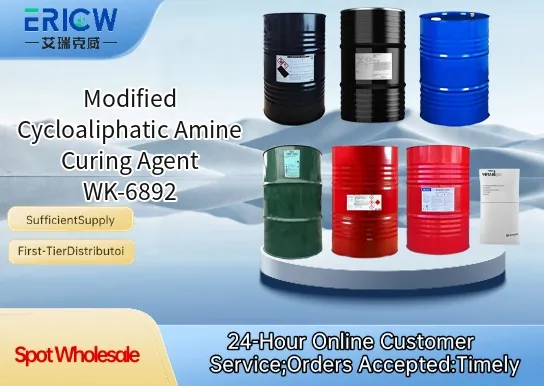
| Chemical Type | Modified cycloaliphatic amine |
| Product Form | Liquid |
| Appearance | Pale yellow to light amber clear liquid |
| Primary Applications | Epoxy resin curing agent for high-performance composites and encapsulants |
| Key Features | Low volatility, moisture-tolerant, room-temperature curable |
| Benefits | Extended working time, reduced post-cure requirements, improved interlaminar shear strength |
| Density (25°C) | 0.92–0.94 g/cm³ |
| Amine Hydrogen Equivalent Weight (AHEW) | 102–108 g/eq |
Q1: What are the key advantages of WK-6892 compared to conventional aliphatic or aromatic amine curing agents?
A: WK-6892 combines the low viscosity and fast reactivity of aliphatic amines with enhanced thermal stability and reduced volatility typical of cycloaliphatic structures. Its modified structure provides improved compatibility with epoxy resins, lower exotherm during cure, and better surface appearance in final coatings or composites—without the handling hazards associated with highly volatile or strongly odorous amines.
Q2: Is WK-6892 suitable for ambient-cure epoxy systems requiring high performance?
A: Yes—WK-6892 is specifically engineered for ambient- and low-temperature-cure applications where rapid development of mechanical properties, chemical resistance, and adhesion are critical. It enables formulators to achieve practical handling strength within hours at room temperature, while still supporting post-cure options for elevated performance.
Q3: How does WK-6892 perform in moisture-sensitive environments?
A: Due to its modified cycloaliphatic backbone, WK-6892 exhibits significantly lower sensitivity to ambient moisture compared to standard primary aliphatic amines. This improves pot life stability and reduces surface defects such as blushing or haziness in humid conditions—though standard moisture control practices during formulation and application are still recommended.
Q4: Can WK-6892 be used in food-contact or industrial protective coating formulations?
A: WK-6892 is designed for high-performance industrial applications including protective coatings, electrical encapsulants, and composite matrices. While it is not inherently restricted for food-contact use, compliance depends entirely on the full formulation—including resin selection, additives, and final cured extractables. End-use regulatory validation must be conducted by the finished product manufacturer.
Contact With Us:
E-mail: wangxingqiang@ericwchem.com
Have a Questions? Call Us:
Add:
Building A1, Jiete Industrial Park, Huangpu District, Guangzhou City, Guangdong Province, China