English
 Español
 tiếng việt
 русский
Excellent melt processability for high-speed extrusion and injection molding
Outstanding low-temperature flexibility down to –40 °C
Good resistance to oils, greases, and non-polar solvents
High abrasion resistance and mechanical toughness
Consistent color stability and low extractables for sensitive applications
Automotive interior trim and soft-touch surfaces
Medical tubing and fluid handling components
Consumer electronics protective casings and grips
Industrial seals and gaskets requiring dynamic flexing
Wire and cable jacketing for demanding environments
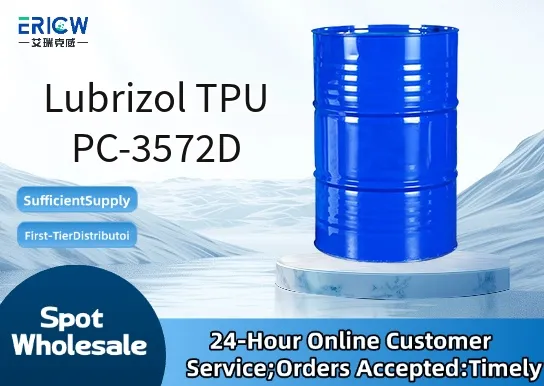
| Chemical Type | Polyester-based thermoplastic polyurethane (TPU) |
| Product Form | Pellets |
| Appearance | Opaque off-white to light tan granules |
| Hardness (Shore A) | 85 ± 3 |
| Melt Flow Rate (210 °C / 2.16 kg) | 10–14 g/10 min |
| Density | 1.18–1.20 g/cm³ |
| Primary Applications | Extruded profiles, injection-molded parts, overmolding substrates |
| Key Features | Process efficiency, low-temperature performance, chemical resilience |
Q1: What is the primary function of Lubrizol TPU PC-3572D in thermoplastic polyurethane (TPU) formulations?
A: Lubrizol TPU PC-3572D is a specialized process aid and surface modifier designed to enhance melt flow, reduce extrusion torque, and improve surface gloss and clarity in TPU compounds—particularly during high-speed processing such as film casting or profile extrusion.
Q2: Is PC-3572D compatible with aromatic and aliphatic TPU grades?
A: Yes, PC-3572D demonstrates broad compatibility across both aromatic and aliphatic TPU chemistries, including polyester- and polyether-based systems. Its performance may vary slightly depending on TPU polarity and molecular weight, so formulation optimization is recommended for specific base resins.
Q3: How should PC-3572D be incorporated into TPU compounds?
A: It is typically introduced via dry blending prior to extrusion or directly dosed into the feed throat of twin-screw extruders. For optimal dispersion, it is recommended to use moderate screw speed and avoid excessive shear in the initial melting zone.
Q4: Does PC-3572D affect the mechanical properties of finished TPU parts?
A: At typical use levels, PC-3572D does not significantly compromise tensile strength, elongation, or hardness. In fact, improved melt homogeneity often contributes to more consistent mechanical performance across production runs.
Q5: Can PC-3572D be used in applications requiring regulatory compliance for food contact or medical devices?
A: PC-3572D is not pre-approved for regulated end uses. Customers intending to use it in food-contact or medical applications must conduct full regulatory evaluation—including extractables profiling and compatibility testing—within their final formulation and processing conditions.
Contact With Us:
E-mail: wangxingqiang@ericwchem.com
Have a Questions? Call Us:
Add:
Building A1, Jiete Industrial Park, Huangpu District, Guangzhou City, Guangdong Province, China