English
 Español
 tiếng việt
 русский
Broad-spectrum efficacy against bacteria, fungi, and algae in industrial water systems.
Stable performance across a wide pH range (pH 4–9) and in the presence of common water treatment additives.
Low-foaming formulation suitable for high-shear and recirculating cooling water applications.
Compatible with oxidizing biocides for synergistic control in challenging microbial environments.
Non-volatile and non-corrosive to mild steel and copper alloys when used at recommended dosage levels.
Cooling tower water treatment in HVAC and industrial process systems.
Once-through and closed-loop recirculating cooling water systems.
Process water circuits in paper mills, food & beverage plants, and textile facilities.
Make-up water lines and storage tanks prone to biofilm formation.
Pretreatment systems upstream of membrane filtration and reverse osmosis units.
| Chemical Type | Isothiazolinone-based non-oxidizing biocide (5-chloro-2-methyl-4-isothiazolin-3-one / 2-methyl-4-isothiazolin-3-one blend) |
| Product Form | Aqueous liquid solution |
| Appearance | Clear, pale yellow to amber liquid |
| pH (as supplied) | 2.0–4.0 |
| Density (at 20 °C) | 1.02–1.06 g/cm³ |
| Active Ingredient Content | 1.5% w/w total isothiazolinones |
| Primary Applications | Non-oxidizing biocide for industrial water treatment |
| Key Features | Fast-acting, residual control, low toxicity to aquatic life when dosed per guidelines |
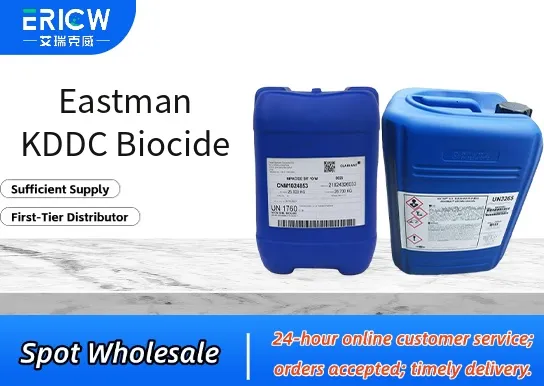
Q1: What is Eastman KDDC Biocide and what makes it suitable for polymer applications?
A: Eastman KDDC Biocide is a broad-spectrum, non-leaching antimicrobial additive designed for incorporation into thermoplastic polymers. Its compatibility with common engineering resins—such as ABS, PC, and polyolefins—and thermal stability during melt processing make it especially well-suited for durable goods requiring long-term microbial resistance.
Q2: How does Eastman KDDC Biocide differ from leaching biocides used in coatings or adhesives?
A: Unlike leaching biocides that rely on controlled release into the surrounding environment, Eastman KDDC Biocide functions primarily through surface contact inhibition. It remains substantially immobilized within the polymer matrix, minimizing migration and supporting compliance with regulatory expectations for articles intended for repeated-use applications.
Q3: Is Eastman KDDC Biocide compatible with common polymer processing methods?
A: Yes—it is formulated for stability under standard thermoplastic processing conditions, including injection molding, extrusion, and blow molding. It demonstrates good dispersion behavior and minimal impact on mechanical properties when incorporated at typical use levels.
Q4: What types of microorganisms does Eastman KDDC Biocide help control?
A: Eastman KDDC Biocide has demonstrated efficacy against a broad range of bacteria (including Gram-positive and Gram-negative strains) and fungi (such as molds and yeasts) commonly associated with polymer degradation, discoloration, or odor development in humid or high-touch environments.
Q5: How should dosage be determined for a specific polymer formulation?
A: Dosage depends on the polymer type, intended end-use environment, required performance duration, and regulatory context. It is typically used at low concentrations—generally ranging from 0.1% to 2% by weight—and should be optimized through application-specific testing and validation.
Contact With Us:
E-mail: wangxingqiang@ericwchem.com
Have a Questions? Call Us:
Add:
Building A1, Jiete Industrial Park, Huangpu District, Guangzhou City, Guangdong Province, China