English
 Español
 tiếng việt
 русский
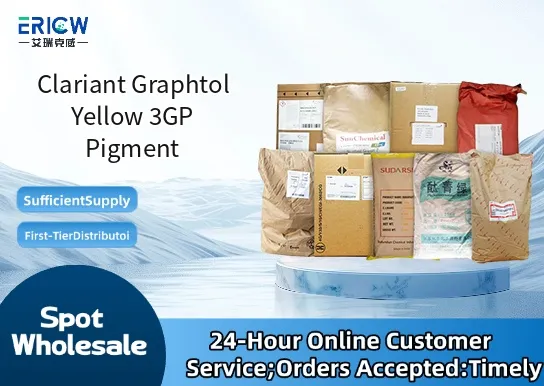
High chroma yellow shade with excellent brightness and clean greenish undertone.
Outstanding lightfastness and weather resistance for durable outdoor applications.
Good thermal stability suitable for low-to-mid temperature polymer processing.
Excellent dispersibility in aqueous and solvent-based systems without requiring aggressive surfactants.
Low volatile organic compound (VOC) contribution, supporting eco-friendly formulation requirements.
Water-based architectural coatings and interior wall paints.
Industrial maintenance coatings for metal and concrete substrates.
Plastic coloration for rigid PVC profiles and polyolefin injection molding.
Printing inks for packaging and label applications (flexographic & gravure).
Wood stains and transparent decorative finishes requiring high transparency and UV tolerance.
| Chemical Type | Azo pigment (monoazo, pyrazolone derivative) |
| Product Form | Fine powder, free-flowing |
| Appearance | Bright yellow to greenish-yellow powder |
| Primary Applications | Coatings, inks, plastics |
| Key Features | High tinting strength, good opacity, low migration |
| Benefits | Consistent batch-to-batch performance, REACH-compliant, non-hazardous classification |
| Recommended Dispersing Media | Water, aliphatic hydrocarbons, esters, ketones |
| Storage Conditions | Store in cool, dry place; protect from direct sunlight and moisture |
Q1: What is the primary chemical class of Graphtol Yellow 3GP?
A: Graphtol Yellow 3GP is an organic pigment based on the monoazo pyridone chemical structure, offering balanced hue, good lightfastness, and thermal stability suitable for demanding industrial applications.
Q2: Is Graphtol Yellow 3GP suitable for use in food-contact plastics?
A: This pigment is not certified for direct food-contact applications. It is intended for general-purpose industrial plastics, coatings, and inks where regulatory compliance for food contact is not required.
Q3: How does Graphtol Yellow 3GP perform under heat during polymer processing?
A: It exhibits good thermal stability and is generally suitable for standard melt-processing conditions of polyolefins and styrenics, though prolonged exposure above 260 °C may affect color strength and hue.
Q4: What dispersion methods are recommended for optimal color development?
A: For best results, high-shear dispersion in the host resin or vehicle is recommended—using twin-screw extruders for plastics or high-speed dissolvers for liquid systems—to ensure complete deagglomeration and uniform distribution.
Q5: Can Graphtol Yellow 3GP be used in water-based systems?
A: Yes—it can be formulated into aqueous dispersions with appropriate surfactants and stabilizers, though performance depends on the specific formulation matrix and pH environment.
Contact With Us:
E-mail: wangxingqiang@ericwchem.com
Have a Questions? Call Us:
Add:
Building A1, Jiete Industrial Park, Huangpu District, Guangzhou City, Guangdong Province, China