English
 Español
 tiếng việt
 русский
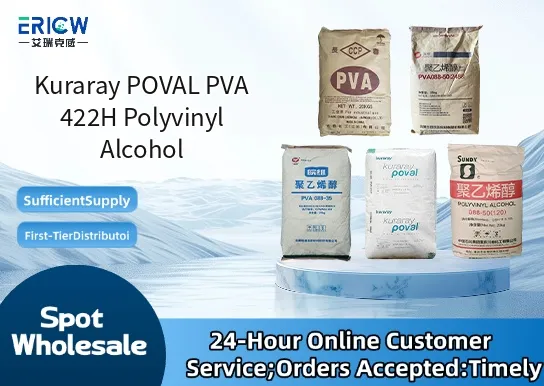
High water solubility with rapid dissolution in cold and warm water.
Excellent film-forming capability yielding transparent, flexible, and strong films.
Good adhesion to polar substrates including paper, wood, and metal surfaces.
Low residual acetyl content ensuring high hydrophilicity and biodegradability.
Consistent batch-to-batch quality supported by Kuraray’s stringent GMP-compliant manufacturing.
Water-soluble packaging films for agrochemicals and detergent pods.
Binder for ceramic and metallurgical green bodies in tape casting and injection molding.
Thickener and stabilizer in aqueous pigment dispersions and textile printing pastes.
Protective coating agent for fibers and paper during processing.
Base polymer for specialty adhesives used in labeling and laminating applications.
| Chemical Type | Polyvinyl alcohol (partially hydrolyzed) |
| Product Form | White to off-white free-flowing powder |
| Appearance | Free of visible impurities; slight characteristic odor |
| Saponification Degree | 87–89 mol% |
| Viscosity (4% aqueous solution at 20°C) | 20–24 mPa·s |
| Residual Acetate Content | 11–13 wt% |
| pH (5% aqueous solution) | 5.0–7.0 |
| Moisture Content | ≤5.0 wt% |
Q1: What is the primary functional advantage of POVAL PVA 422H compared to other PVA grades?
A: POVAL PVA 422H offers a balanced combination of moderate water solubility, good film-forming capability, and enhanced adhesion to polar substrates—making it especially suitable for applications requiring cohesive strength and controlled dissolution in aqueous systems.
Q2: Is POVAL PVA 422H suitable for use in water-soluble packaging films?
A: Yes, it is commonly employed in water-soluble packaging formulations due to its reliable film integrity in dry conditions and predictable dissolution behavior under controlled humidity or immersion—though final performance depends on formulation design and environmental exposure conditions.
Q3: How does temperature affect the dissolution rate of POVAL PVA 422H in water?
A: Dissolution is generally faster at elevated temperatures (e.g., above 40 °C), but the grade exhibits practical cold-water dispersibility with gentle agitation—enabling flexibility across processing conditions without requiring aggressive heating.
Q4: Can POVAL PVA 422H be blended with other water-soluble polymers such as PVP or CMC?
A: Yes, it demonstrates good compatibility with several common water-soluble polymers, supporting synergistic effects in viscosity modification, film toughness, and substrate adhesion—though compatibility should be verified experimentally for each specific formulation.
Q5: What are typical handling and storage recommendations to maintain product stability?
A: Store in a cool, dry place in original sealed packaging to prevent moisture uptake; avoid prolonged exposure to high humidity or elevated temperatures, which may lead to partial agglomeration or reduced flowability over time.
Contact With Us:
E-mail: wangxingqiang@ericwchem.com
Have a Questions? Call Us:
Add:
Building A1, Jiete Industrial Park, Huangpu District, Guangzhou City, Guangdong Province, China