English
 Español
 tiếng việt
 русский
Excellent adhesion to glass and various substrates, ensuring reliable interlayer bonding in laminated safety glass.
High optical clarity and low haze, meeting stringent requirements for automotive and architectural glazing applications.
Superior impact resistance and tear strength, contributing to enhanced safety performance under dynamic loading conditions.
Good thermal stability and consistent melt flow behavior during extrusion and calendering processes.
Low residual acetaldehyde content, supporting compliance with automotive interior air quality standards (e.g., VDA 278).
Automotive laminated windshields and side windows.
Architectural safety glazing for commercial buildings and façades.
Photovoltaic module encapsulation layers (frontsheet interlayer).
Security and blast-resistant glazing systems.
Sound-dampening interlayers in acoustic laminated glass.
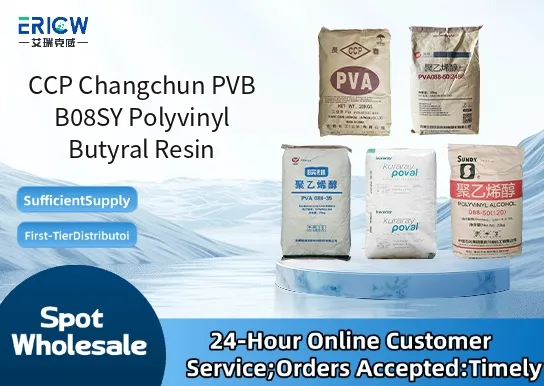
| Chemical Type | Polyvinyl butyral (PVB) copolymer |
| Product Form | Free-flowing granules |
| Appearance | Off-white to pale yellow, uniform granular solid |
| Primary Applications | Laminated safety glass interlayer |
| Key Features | High adhesion, optical clarity, toughness, processability |
| Benefits | Enhanced occupant safety, UV blocking, sound attenuation, dimensional stability |
| Storage Conditions | Store in cool, dry, well-ventilated area; avoid direct sunlight and moisture |
| Standard Packaging | 25 kg multi-layer paper/polyethylene bags with inner PE liner |
Q1: What are the primary functional benefits of CCP Changchun PVB B08SY in adhesive and coating formulations?
A: PVB B08SY provides excellent adhesion to polar substrates—including glass, metals, and treated plastics—along with strong film-forming capability, good flexibility, and enhanced moisture resistance. Its balanced molecular weight and butyralization degree support consistent dispersion and compatibility in solvent-based systems.
Q2: Is PVB B08SY suitable for use in laminated safety glass interlayers?
A: While PVB B08SY shares the core polyvinyl butyral chemistry used in safety glass applications, it is specifically optimized for industrial coatings, inks, and specialty adhesives—not structural laminated interlayers. For architectural or automotive safety glass, dedicated high-purity, high-viscosity PVB resins with certified optical and mechanical performance are recommended.
Q3: How should PVB B08SY be dissolved and handled in formulation processes?
A: PVB B08SY dissolves readily in common organic solvents such as ethanol, isopropanol, ethyl acetate, and ketones (e.g., MEK, acetone). Optimal dissolution typically occurs at ambient to moderately elevated temperatures with moderate agitation. Pre-dissolving in a portion of solvent before adding to the full batch helps prevent agglomeration and ensures uniform incorporation.
Q4: What compatibility considerations should be observed when blending PVB B08SY with other resins or additives?
A: PVB B08SY demonstrates good compatibility with many cellulose derivatives, acrylics, and certain phenolic resins in solvent-based systems. However, compatibility with highly polar or ionic additives—or water-based dispersions—should be verified experimentally, as phase separation may occur depending on formulation pH, solvent polarity, and shear conditions.
Contact With Us:
E-mail: wangxingqiang@ericwchem.com
Have a Questions? Call Us:
Add:
Building A1, Jiete Industrial Park, Huangpu District, Guangzhou City, Guangdong Province, China