English
 Español
 tiếng việt
 русский
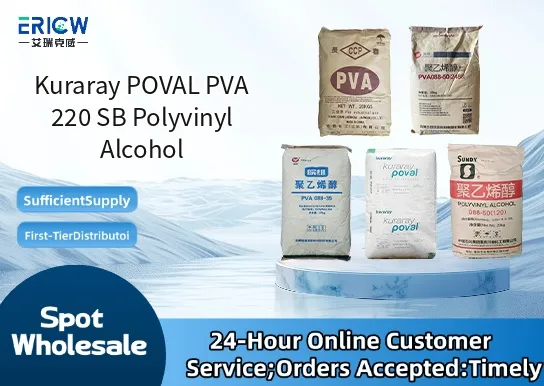
High water solubility with rapid dissolution in cold and warm water.
Excellent film-forming capability yielding transparent, flexible, and strong films.
Superior adhesion to polar substrates including paper, cellulose, and metals.
Low residual acetyl content ensuring high hydrophilicity and biodegradability.
Consistent batch-to-batch quality supported by Kuraray’s stringent GMP-aligned manufacturing.
Water-soluble packaging films for agrochemicals and detergent pods.
Binders in ceramic and refractory green bodies for improved dry strength.
Thickener and rheology modifier in aqueous coatings and pigment dispersions.
Protective colloid in emulsion polymerization (e.g., vinyl acetate, acrylics).
Stabilizer and dispersant in lithium-ion battery electrode slurries.
| Chemical Type | Polyvinyl alcohol (partially hydrolyzed) |
| Product Form | White granular powder |
| Appearance | Free-flowing, odorless granules |
| Saponification Degree | 87–89 mol% |
| Viscosity (4% aqueous solution at 20°C) | 20–23 mPa·s |
| Residual Acetate Content | 11–13 wt% |
| pH (5% aqueous solution) | 5.5–7.0 |
| Moisture Content | ≤5.0 wt% |
Q1: What distinguishes POVAL PVA 220 SB from other polyvinyl alcohol grades?
A: POVAL PVA 220 SB is a fully hydrolyzed, low-viscosity grade designed for applications requiring rapid dissolution, excellent film-forming capability, and high water solubility. Its balanced molecular weight and narrow particle size distribution support consistent performance in aqueous formulations, especially where clarity, adhesion, and compatibility with polar systems are critical.
Q2: Is POVAL PVA 220 SB suitable for use in water-soluble packaging films?
A: Yes — this grade is commonly selected for water-soluble packaging due to its high degree of hydrolysis, robust film strength when dry, and controlled dissolution profile in cold to warm water. Performance in end-use conditions depends on film thickness, humidity exposure, and formulation additives.
Q3: How should POVAL PVA 220 SB be dissolved for optimal results?
A: For best dissolution, gradually disperse the powder into cold water under gentle agitation to prevent agglomeration, then heat the slurry to 80–90°C while maintaining mixing until fully transparent. Avoid direct addition to boiling water, as surface gelation may hinder complete hydration.
Q4: Can POVAL PVA 220 SB be blended with other water-soluble polymers or surfactants?
A: Yes — it demonstrates good compatibility with many common water-soluble polymers (e.g., PVP, CMC, certain cellulose ethers) and nonionic surfactants. Compatibility with ionic species or highly acidic/basic systems should be verified experimentally, as pH and ionic strength can influence solution stability and viscosity.
Contact With Us:
E-mail: wangxingqiang@ericwchem.com
Have a Questions? Call Us:
Add:
Building A1, Jiete Industrial Park, Huangpu District, Guangzhou City, Guangdong Province, China