English
 Español
 tiếng việt
 русский
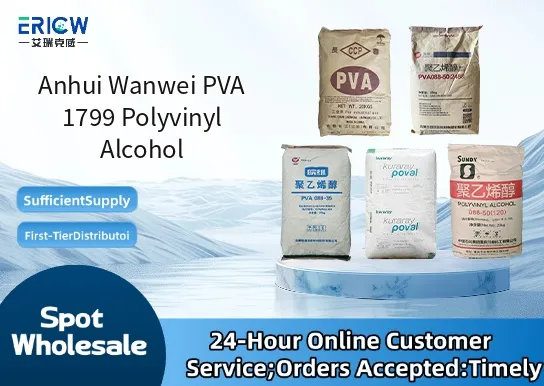
High degree of hydrolysis (~99%) ensuring excellent water solubility and film-forming capability.
Consistent molecular weight distribution (viscosity grade 17–22 mPa·s for 4% aqueous solution at 20°C).
Low residual acetate content (<1.5%), contributing to superior thermal stability and chemical resistance.
Free-flowing white granular or powder form with low dust generation for safe handling and metering.
Non-toxic, biodegradable, and compliant with GB/T 12010.1–2009 and ISO 15236 standards.
Binders in ceramic green bodies and refractory shaping processes.
Thickener and stabilizer in textile sizing formulations for warp yarn protection.
Adhesive component in paper coating, laminating, and corrugated board production.
Dispersant and protective colloid in emulsion polymerization (e.g., VAE, SBR latex synthesis).
Base polymer for water-soluble films used in agrochemical packaging and detergent pods.
| Chemical Type | Polyvinyl alcohol (fully hydrolyzed) |
| Product Form | White granules or free-flowing powder |
| Appearance | White to off-white, odorless solid |
| Viscosity (4% aq. sol., 20°C) | 17–22 mPa·s |
| Hydrolysis Degree | 98.5–99.0 mol% |
| Residual Acetate Content | ≤1.5 wt% |
| Volatiles (105°C, 2 h) | ≤5.0 wt% |
| pH (5% aqueous solution) | 5.5–7.0 |
Q1: What does the “1799” designation mean in PVA 1799?
A: The “1799” refers to the nominal degree of polymerization and hydrolysis: approximately 1700 repeating units per chain and ≥99% hydrolysis. This indicates a high molecular weight and very high saponification level, resulting in excellent film strength, water solubility at elevated temperatures, and strong intermolecular hydrogen bonding.
Q2: How does PVA 1799 differ from lower-hydrolysis grades like PVA 1788 or PVA 2499?
A: Compared to partially hydrolyzed grades (e.g., 87–89%), PVA 1799 exhibits significantly lower residual acetate content, leading to reduced cold-water solubility but enhanced thermal stability, crystallinity, and adhesion to polar substrates. Unlike higher-molecular-weight variants (e.g., 2499), it balances viscosity build-up and processability in aqueous systems without excessive gelation risk.
Q3: In which types of formulations is Anhui Wanwei PVA 1799 most commonly used?
A: It is widely employed as a binder, thickener, and film-former in water-based adhesives, textile sizing agents, ceramic green-body binders, and paper coatings. Its high hydrolysis supports compatibility with other water-soluble polymers and enables robust film formation after drying—especially where moisture resistance and mechanical integrity are required.
Q4: What are key handling considerations when dissolving PVA 1799?
A: Due to its high hydrolysis, PVA 1799 requires gradual dispersion in cold water followed by heating to 85–95°C for complete dissolution. Agitation is essential to prevent surface gelation. Avoid prolonged exposure to temperatures above 100°C, as thermal degradation may reduce viscosity and film performance. Pre-wetting with glycerol or alcohol can aid dispersion in some industrial processes.
Contact With Us:
E-mail: wangxingqiang@ericwchem.com
Have a Questions? Call Us:
Add:
Building A1, Jiete Industrial Park, Huangpu District, Guangzhou City, Guangdong Province, China