English
 Español
 tiếng việt
 русский
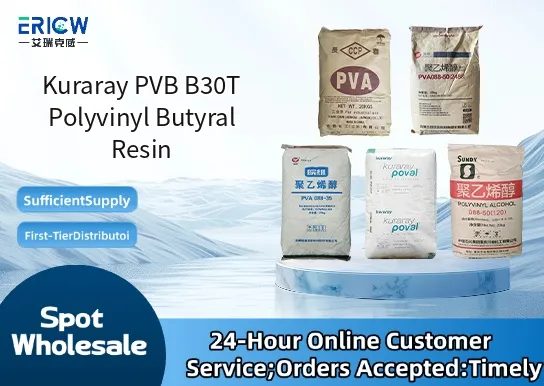
High clarity and excellent optical transparency for premium laminated safety glass performance.
Optimized melt flow characteristics enabling smooth extrusion and uniform interlayer formation.
Superior adhesion to both glass and polycarbonate substrates without requiring primers.
Excellent UV stability and long-term yellowing resistance under accelerated weathering conditions.
Consistent batch-to-batch quality ensured by Kuraray’s proprietary polymerization and purification process.
Laminated automotive windshields and side windows.
Architectural safety glass for facades, skylights, and overhead glazing.
Security glazing systems including blast-resistant and forced-entry resistant laminates.
Photovoltaic module encapsulation layers for enhanced durability and moisture barrier performance.
Acoustic laminated glass for noise reduction in transportation and building applications.
| Chemical Type | Polyvinyl butyral (PVB) copolymer |
| Product Form | Free-flowing white granules |
| Appearance | Off-white to light yellow granular solid |
| Primary Applications | Safety interlayer for laminated glass |
| Key Features | High adhesion, optical clarity, thermal processability |
| Benefits | Improved lamination yield, reduced delamination risk, consistent optical quality |
| Storage Conditions | Store in cool, dry location; protect from moisture and direct sunlight |
| Compliance | Meets ISO 12543-3 for laminated glass interlayers |
Q1: What is the primary function of Kuraray PVB B30T in adhesive and coating formulations?
A: Kuraray PVB B30T serves primarily as a film-forming binder and adhesion promoter, enhancing cohesion, flexibility, and substrate bonding—especially on polar surfaces such as glass, metals, and treated plastics.
Q2: How does PVB B30T compare to other PVB grades in terms of solubility and processing?
A: PVB B30T offers balanced solubility in common organic solvent blends (e.g., alcohols, ketones, esters), enabling straightforward dissolution at ambient to moderately elevated temperatures—without requiring aggressive heating or extended mixing times typical of higher-molecular-weight PVB resins.
Q3: Is PVB B30T suitable for use in safety glazing interlayers?
A: While PVB B30T shares the core chemical structure of safety-grade PVB resins, it is formulated for general-purpose industrial applications—not certified for laminated architectural or automotive safety glass interlayers, which require specialized high-purity, high-viscosity, and tightly controlled rheological grades.
Q4: What types of formulation adjustments are typically needed when substituting PVB B30T for another resin?
A: Substitution may require minor optimization of solvent ratios and drying profiles due to its distinct volatility response and film coalescence behavior; viscosity adjustment is often minimal, but compatibility testing with plasticizers, crosslinkers, or pigments is recommended before full-scale implementation.
Contact With Us:
E-mail: wangxingqiang@ericwchem.com
Have a Questions? Call Us:
Add:
Building A1, Jiete Industrial Park, Huangpu District, Guangzhou City, Guangdong Province, China