English
 Español
 tiếng việt
 русский
Excellent adhesion to glass and various substrates, ensuring strong interlayer bonding in laminated safety glass.
Superior clarity and optical transparency with low haze, meeting stringent automotive and architectural glazing standards.
High tensile strength and elongation at break, providing outstanding impact resistance and post-breakage integrity.
Good compatibility with plasticizers (e.g., triethylene glycol di-2-ethylhexanoate) for tailored film flexibility and processing performance.
Consistent batch-to-batch quality and thermal stability suitable for high-speed extrusion and calendering processes.
Laminated automotive windshields and side windows.
Safety and security glazing for commercial buildings and facades.
Photovoltaic module encapsulation layers (frontsheet interlayer).
Sound-dampening laminated glass for noise-sensitive environments.
Interior decorative laminated glass panels and partitions.
| Chemical Type | Polyvinyl butyral (PVB) resin |
| Product Form | Free-flowing off-white granules |
| Appearance | Uniform granular solid, free from visible specks or discoloration |
| Butyral Content | 65–69 wt% |
| Hydroxyl Content | 18–22 wt% |
| Vinyl Alcohol Content | 12–16 wt% |
| Gel Content (in THF) | ≤ 0.5% |
| Moisture Content | ≤ 0.5 wt% |
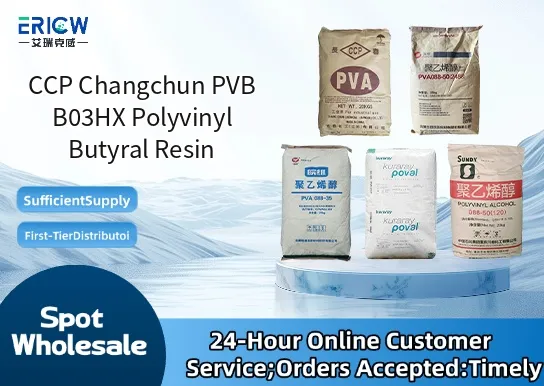
Q1: What are the primary functional benefits of CCP Changchun PVB B03HX in adhesive and coating formulations?
A: PVB B03HX offers excellent adhesion to polar substrates—including glass, metals, and treated plastics—as well as good flexibility, film-forming capability, and compatibility with a broad range of solvents and resins. Its balanced hydroxyl and butyral content supports strong interfacial bonding while maintaining workable viscosity and drying characteristics.
Q2: Is PVB B03HX suitable for use in laminated safety glass interlayers?
A: While PVB B03HX shares the core polyvinyl butyral chemistry used in safety glass interlayers, it is specifically designed for solvent-based adhesives, primers, and protective coatings—not for structural interlayer films requiring certified impact resistance or optical clarity specifications. For safety glass applications, dedicated high-purity, high-molecular-weight PVB grades are recommended.
Q3: How should PVB B03HX be dissolved and handled in formulation processes?
A: PVB B03HX dissolves readily in common organic solvents such as ethanol, isopropanol, ethyl acetate, and ketones (e.g., MEK, acetone), typically requiring gentle agitation at ambient to moderately elevated temperatures. Avoid prolonged heating above 60 °C in open systems to minimize potential degradation. Pre-dissolution in alcohol before adding to slower-evaporating solvents is often recommended for uniform dispersion.
Q4: What types of crosslinkers or additives are commonly compatible with PVB B03HX?
A: PVB B03HX is frequently used with melamine-formaldehyde and urea-formaldehyde resins, as well as blocked isocyanates, to enhance thermal stability and chemical resistance. It also shows good compatibility with plasticizers (e.g., dibutyl phthalate, triethyl citrate) to adjust film flexibility, and with UV stabilizers when extended outdoor durability is required.
Q5: Does PVB B03HX require special storage or handling precautions?
A: Store in a cool, dry place away from direct sunlight and sources of heat or ignition. Keep containers tightly sealed to prevent moisture absorption and solvent loss. As with all organic resins, ensure adequate ventilation during handling and follow standard industrial hygiene practices—consult the Safety Data Sheet (SDS) for specific occupational exposure guidance.
Contact With Us:
E-mail: wangxingqiang@ericwchem.com
Have a Questions? Call Us:
Add:
Building A1, Jiete Industrial Park, Huangpu District, Guangzhou City, Guangdong Province, China