English
 Español
 tiếng việt
 русский
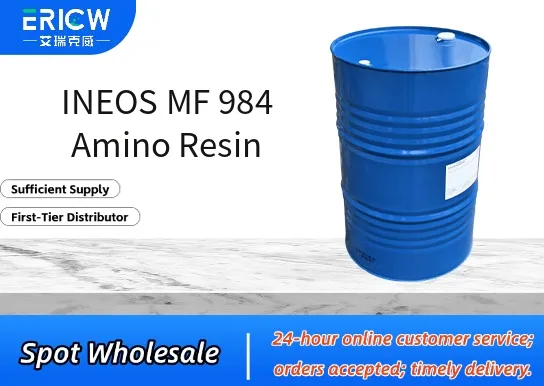
High reactivity with formaldehyde and melamine-based crosslinkers for rapid cure kinetics.
Excellent compatibility with polyester, acrylic, and alkyd resin systems.
Provides superior hardness, gloss retention, and chemical resistance in cured films.
Low volatile organic compound (VOC) content, supporting compliant coating formulations.
Consistent batch-to-batch performance and thermal stability during baking processes.
Automotive OEM and refinish topcoats requiring high-gloss, durable finishes.
Industrial coil coatings for pre-painted metal substrates.
Appliance enamel coatings demanding excellent chip resistance and weatherability.
General-purpose can coatings for food and beverage containers.
Wood furniture and panel coatings requiring fast through-cure and low-temperature bake profiles.
| Chemical Type | Melamine-formaldehyde condensate |
| Product Form | Clear to pale yellow liquid |
| Appearance | Homogeneous, free-flowing liquid |
| Solvent Content | Butanol/water mixture (approx. 70–75% solids) |
| pH (10% aqueous solution) | 7.5–8.5 |
| Viscosity (25°C, Brookfield RV, spindle #3, 20 rpm) | 150–350 mPa·s |
| Reactive Groups | Methylol and methoxy groups |
| Primary Applications | Crosslinker for thermosetting coatings and inks |
Q1: What is the primary function of INEOS MF 984 in coating and ink formulations?
A: INEOS MF 984 is a melamine-formaldehyde amino resin designed primarily as a crosslinking agent for thermosetting systems. It reacts with hydroxyl- or carboxyl-functional resins—such as alkyds, acrylics, or polyesters—to enhance hardness, chemical resistance, and thermal stability in cured films.
Q2: Is INEOS MF 984 compatible with water-based systems?
A: Yes, INEOS MF 984 is formulated to be compatible with both solvent-borne and water-reducible systems. Its solubility profile allows for stable incorporation into aqueous dispersions when properly adjusted for pH and co-solvent selection, though formulation optimization is recommended for each specific system.
Q3: How should INEOS MF 984 be stored to maintain optimal performance?
A: Store in tightly sealed original containers at temperatures between 5 °C and 30 °C, away from direct sunlight and strong oxidizing agents. Prolonged exposure to freezing conditions or excessive heat may affect viscosity and reactivity; always inspect for clarity and absence of sediment before use.
Q4: Does INEOS MF 984 require acid catalysis for efficient curing?
A: Yes, acid catalysts—such as p-toluenesulfonic acid (p-TSA) or blocked acid systems—are typically required to accelerate the crosslinking reaction at practical baking temperatures. Catalyst type and dosage must be carefully balanced to avoid premature gelation or film defects.
Q5: Can INEOS MF 984 be used in food-contact coatings?
A: INEOS MF 984 is not pre-approved for direct food-contact applications. Its suitability depends on full compliance with applicable regional regulations and final formulation testing—including migration assessment—under end-use conditions. Customers must conduct their own regulatory evaluation and obtain necessary authorizations prior to use in such applications.
Contact With Us:
E-mail: wangxingqiang@ericwchem.com
Have a Questions? Call Us:
Add:
Building A1, Jiete Industrial Park, Huangpu District, Guangzhou City, Guangdong Province, China