English
 Español
 tiếng việt
 русский
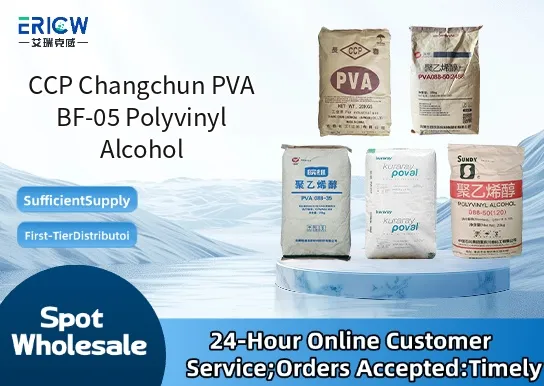
High water solubility with rapid dissolution in cold and warm water.
Excellent film-forming capability yielding transparent, flexible, and strong films.
Superior adhesion to porous substrates including paper, wood, and cellulose fibers.
Good compatibility with starch, latex, and other water-soluble polymers.
Low residual acetaldehyde content, meeting stringent safety requirements for industrial use.
Water-based adhesive formulations for packaging and labeling.
Binders in ceramic and refractory green bodies.
Thickener and rheology modifier in construction mortars and tile adhesives.
Protective colloids in emulsion polymerization processes.
Release agent component in fiber spinning and textile sizing applications.
| Chemical Type | Polyvinyl alcohol (partially hydrolyzed) |
| Product Form | White granular powder |
| Appearance | Free-flowing, odorless white granules |
| Saponification Degree | 87–89 mol% |
| Viscosity (4% aqueous solution, 20°C) | 4.5–5.5 mPa·s |
| Volatiles (105°C, 2 hrs) | ≤5.0 wt% |
| pH (1% aqueous solution) | 5.5–6.5 |
| Residue on Ignition | ≤0.5 wt% |
Q1: What is the primary functional role of CCP Changchun PVA BF-05 in water-based formulations?
A: PVA BF-05 serves primarily as a film-forming binder and rheology modifier in aqueous systems. Its partial hydrolysis degree and moderate molecular weight support good solubility, cohesive strength, and adhesion to polar substrates—making it especially suitable for coatings, adhesives, and textile sizing applications.
Q2: How does BF-05 compare to higher-viscosity PVA grades in terms of processing and application performance?
A: BF-05 offers lower solution viscosity at equivalent concentrations compared to high-molecular-weight PVAs, enabling easier handling, pumping, and spray application. It provides balanced film integrity and flexibility without excessive tack or prolonged drying times—ideal where process efficiency and controlled film formation are priorities.
Q3: Is BF-05 compatible with common crosslinkers used in industrial coatings or adhesives?
A: Yes, BF-05 is generally compatible with aldehyde-based (e.g., glyoxal) and aziridine-type crosslinkers, supporting enhanced water resistance and mechanical durability in cured films. Compatibility and optimal dosage should be verified under actual formulation conditions due to sensitivity to pH, temperature, and co-additives.
Q4: What are typical storage and handling recommendations for BF-05 powder?
A: Store in a cool, dry place away from direct sunlight and moisture. Keep containers tightly sealed to prevent hygroscopic absorption, which may affect dissolution rate and solution clarity. When dissolving, gradual addition to cold water with continuous agitation is recommended to avoid lumping; heating to 80–90°C may be applied after initial dispersion to accelerate full hydration.
Contact With Us:
E-mail: wangxingqiang@ericwchem.com
Have a Questions? Call Us:
Add:
Building A1, Jiete Industrial Park, Huangpu District, Guangzhou City, Guangdong Province, China