English
 Español
 tiếng việt
 русский
High water solubility with rapid dissolution in cold to warm water.
Excellent film-forming capability and strong adhesion to polar substrates.
Good compatibility with starch, cellulose derivatives, and many synthetic polymers.
Controlled hydrolysis degree (87–89 mol%) ensures balanced solubility and film strength.
Low residual acetyl content enhances biodegradability and reduces odor.
Water-soluble packaging films for agrochemicals and detergent pods.
Binder in ceramic and refractory green bodies for improved dry strength.
Thickener and stabilizer in aqueous pigment dispersions and inkjet inks.
Temporary protective coating for metal surfaces during machining or storage.
Matrix polymer in electrospun nanofibers for filtration and biomedical scaffolds.
| Chemical Type | Polyvinyl alcohol (partially hydrolyzed) |
| Product Form | Free-flowing white granular powder |
| Appearance | White to off-white granules |
| Hydrolysis Degree | 87–89 mol% |
| Viscosity (4% aqueous solution, 20°C) | 12.5–14.5 mPa·s |
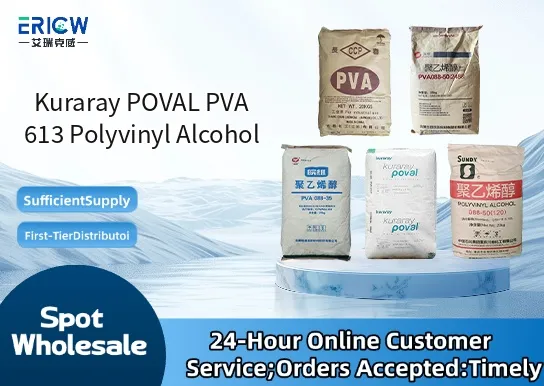
| sPVA Grade Designation | Kuraray POVAL® PVA 613 |
| Residual Acetate Content | 11–13 mol% |
| pH (1% aqueous solution) | 5.5–7.0 |
Q1: What is the typical degree of hydrolysis and viscosity profile of POVAL PVA 613?
A: POVAL PVA 613 is a partially hydrolyzed polyvinyl alcohol with a medium degree of hydrolysis, offering balanced water solubility and film-forming capability. Its aqueous solution exhibits moderate viscosity at standard concentrations, supporting easy handling in industrial mixing and coating processes.
Q2: How does POVAL PVA 613 perform in adhesive formulations?
A: It serves as an effective binder and rheology modifier in water-based adhesives, enhancing green strength, tack development, and substrate adhesion—particularly on porous materials like paper, cardboard, and textiles. Its compatibility with starch, acrylics, and other common polymer dispersions makes it suitable for hybrid systems.
Q3: Is POVAL PVA 613 suitable for use in textile sizing applications?
A: Yes—it is widely used in warp sizing due to its excellent film flexibility, abrasion resistance, and easy removability during desizing. The polymer forms cohesive yet extensible films that protect yarns during weaving without excessive stiffness or brittleness.
Q4: Can POVAL PVA 613 be blended with other water-soluble polymers?
A: Yes, it demonstrates good miscibility with many water-soluble polymers including carboxymethyl cellulose (CMC), polyacrylamide, and certain modified starches. Compatibility should be confirmed experimentally for specific formulation conditions, especially under varying pH or ionic strength.
Q5: What are key storage and handling considerations for POVAL PVA 613 powder?
A: Store in a cool, dry place in original sealed packaging to prevent moisture absorption and caking. Avoid exposure to high humidity or temperature fluctuations. When dissolving, gradual addition with vigorous agitation helps prevent lump formation and ensures uniform dispersion.
Contact With Us:
E-mail: wangxingqiang@ericwchem.com
Have a Questions? Call Us:
Add:
Building A1, Jiete Industrial Park, Huangpu District, Guangzhou City, Guangdong Province, China