English
 Español
 tiếng việt
 русский
High gloss and excellent clarity for premium aesthetic performance.
Outstanding alkali resistance, enabling compatibility with cementitious substrates and alkaline formulations.
Low VOC content, supporting compliance with stringent environmental regulations including EU Ecolabel and Green Seal standards.
Good freeze-thaw stability (3 cycles at −5 °C to 25 °C), ensuring reliable storage and handling in variable climates.
Excellent film formation at ambient temperatures without coalescent aids.
Exterior architectural coatings for concrete, stucco, and masonry surfaces.
High-performance elastomeric wall coatings requiring crack bridging and weather resistance.
Waterproofing membranes and protective topcoats for infrastructure applications.
Decorative and functional façade systems, including textured and smooth finish renders.
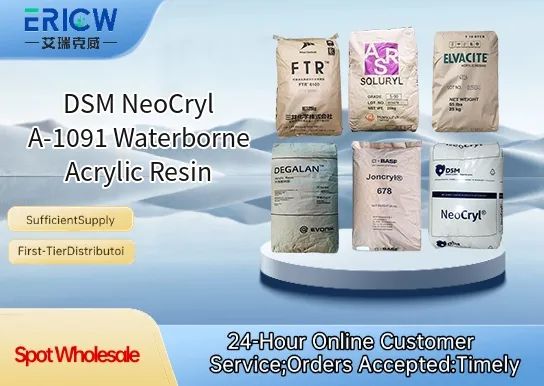
| Chemical Type | Acrylic copolymer dispersion |
| Product Form | White to slightly bluish opaque liquid |
| Appearance | Homogeneous aqueous dispersion |
| Solids Content (wt%) | 48 ± 1% |
| pH | 8.0 – 9.0 |
| Viscosity (mPa·s, Brookfield RVT, #2 spindle, 20 rpm) | 100 – 400 |
| Density (g/cm³ at 25 °C) | 1.01 – 1.03 |
| Minimum Film Formation Temperature (MFFT) | ≈ 12 °C |
Q1: What is the primary application area for NeoCryl A-1091?
A: NeoCryl A-1091 is primarily formulated into high-performance waterborne architectural and industrial maintenance coatings, where excellent block resistance, scrub resistance, and low-temperature film formation are required.
Q2: Is NeoCryl A-1091 compatible with common coalescing agents and rheology modifiers used in acrylic emulsion systems?
A: Yes — NeoCryl A-1091 demonstrates broad compatibility with standard coalescents (e.g., Texanol®, DOWANOL™ PnB) and associative and non-associative thickeners, though optimal performance should be verified through formulation testing under intended use conditions.
Q3: How does NeoCryl A-1091 perform in terms of alkali resistance compared to conventional acrylic emulsions?
A: NeoCryl A-1091 offers enhanced alkali resistance due to its optimized polymer architecture, making it particularly suitable for interior masonry and plaster-based substrates where pH exposure may occur during early service life.
Q4: Can NeoCryl A-1091 be used in formulations targeting low-VOC or zero-VOC compliance?
A: Yes — as a 100% waterborne acrylic dispersion with negligible VOC content, NeoCryl A-1091 supports formulations designed to meet stringent regional low-VOC requirements when combined with compliant additives and pigments.
Contact With Us:
E-mail: wangxingqiang@ericwchem.com
Have a Questions? Call Us:
Add:
Building A1, Jiete Industrial Park, Huangpu District, Guangzhou City, Guangdong Province, China