English
 Español
 tiếng việt
 русский
High adhesion strength to glass and polycarbonate substrates.
Excellent optical clarity and long-term UV stability.
Superior impact resistance and energy absorption performance.
Consistent melt viscosity for reliable extrusion and lamination processing.
Low moisture absorption for enhanced dimensional stability in laminated safety glazing.
Automotive laminated safety glass (windshields, sunroofs).
Architectural laminated glass for facades and skylights.
Security and blast-resistant glazing systems.
Photovoltaic module encapsulation (front-side interlayer).
Acoustic laminated glass for noise reduction in transportation and buildings.
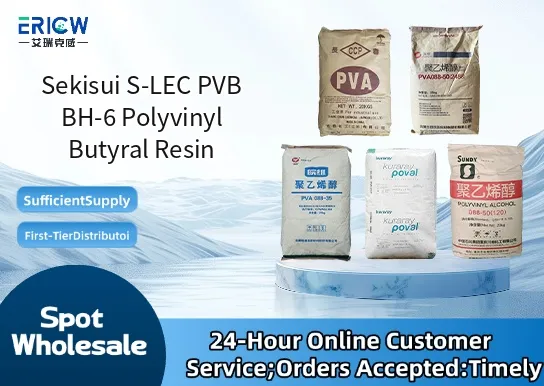
| Chemical Type | Polyvinyl butyral (PVB) resin |
| Product Form | Free-flowing white granules |
| Appearance | Off-white to light yellow granules |
| Primary Applications | Laminated safety glass interlayer |
| Key Features | High clarity, low haze, excellent interlayer bonding |
| Benefits | Enhanced safety performance, process reliability, weatherability |
| Standard Packaging | 25 kg multi-layer paper/polyethylene bag |
| Storage Conditions | Store in cool, dry place; avoid direct sunlight and moisture |
Q1: What is the primary functional role of S-LEC PVB BH-6 in adhesive and coating formulations?
A: S-LEC PVB BH-6 serves primarily as a high-performance binder and adhesion promoter, enhancing interfacial bonding between dissimilar substrates—especially in laminated safety glass interlayers and specialty industrial coatings—due to its balanced polarity, excellent film-forming capability, and strong affinity for both polar and non-polar surfaces.
Q2: How does BH-6 differ from other grades in the S-LEC PVB series, such as BH-3 or BH-9?
A: BH-6 is formulated with an intermediate butyralization degree and molecular weight, offering a balanced profile between flexibility and cohesive strength—making it particularly suitable for applications requiring moderate elongation and robust moisture resistance without excessive rigidity or brittleness.
Q3: Is S-LEC PVB BH-6 compatible with common solvents used in industrial coating systems?
A: Yes, BH-6 demonstrates good solubility in typical organic solvent blends, including alcohols (e.g., ethanol, isopropanol), ketones (e.g., methyl ethyl ketone), and esters (e.g., ethyl acetate), enabling straightforward integration into solvent-borne coating and adhesive formulations.
Q4: Can BH-6 be used in formulations intended for food-contact or medical applications?
A: While S-LEC PVB resins are widely employed in demanding technical applications, BH-6 is not pre-qualified for direct food-contact or medical device use. Formulators must conduct full regulatory evaluation—including extractables testing and compliance verification—based on their specific end-use conditions and regional requirements.
Contact With Us:
E-mail: wangxingqiang@ericwchem.com
Have a Questions? Call Us:
Add:
Building A1, Jiete Industrial Park, Huangpu District, Guangzhou City, Guangdong Province, China