English
 Español
 tiếng việt
 русский
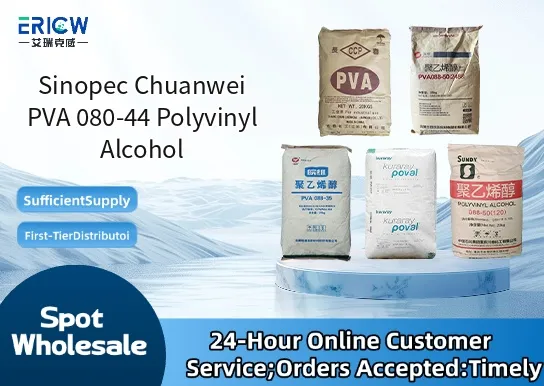
High water solubility with rapid dissolution in cold and warm water.
Excellent film-forming capability and strong adhesion to polar substrates.
Good thermal stability and consistent viscosity performance during processing.
Low residual acetaldehyde content, meeting stringent environmental and safety standards.
Controlled degree of hydrolysis (~87–89 mol%), ensuring balanced water resistance and biodegradability.
Water-soluble packaging films for agrochemicals and detergent pods.
Binder in textile sizing for synthetic and blended yarns.
Adhesive component in paper coating and laminating formulations.
Thickener and stabilizer in construction mortar additives.
Carrier matrix for controlled-release pharmaceutical granules.
| Chemical Type | Polyvinyl alcohol (partially hydrolyzed) |
| Product Form | White to off-white free-flowing powder |
| Appearance | Uniform granular powder, no visible impurities |
| Degree of Hydrolysis | 87–89 mol% |
| Viscosity (4% aqueous solution at 20°C) | 42–46 mPa·s |
| Volatile Matter (105°C, 2 h) | ≤5.0 wt% |
| pH (1% aqueous solution) | 5.0–6.5 |
| Solubility | Completely soluble in water; insoluble in organic solvents |
Q1: What does the designation "080-44" indicate for this PVA grade?
A: The "080" refers to an approximate average degree of polymerization (~800), and "44" indicates a nominal hydrolysis degree of approximately 88%–90%, classifying it as a partially hydrolyzed, water-soluble polyvinyl alcohol with balanced solubility and film-forming performance.
Q2: How does Sinopec Chuanwei PVA 080-44 differ from fully hydrolyzed PVA grades in terms of application behavior?
A: Due to its partial hydrolysis, PVA 080-44 offers improved cold-water dispersibility and reduced gelation tendency compared to fully hydrolyzed grades, making it especially suitable for applications requiring rapid dissolution at ambient temperatures—such as textile sizing, paper coating binders, and certain agrochemical formulations.
Q3: Is this PVA grade compatible with common industrial surfactants and electrolytes?
A: Yes, PVA 080-44 generally exhibits good compatibility with nonionic and anionic surfactants, as well as moderate tolerance to low concentrations of common salts. However, formulation stability should be verified experimentally when high electrolyte levels or cationic additives are present.
Q4: What is the typical handling guidance for dissolving PVA 080-44 in aqueous systems?
A: For optimal dispersion, gradually sprinkle the powder into vigorously stirred cold or ambient water to prevent agglomeration. Gentle heating (up to ~90°C) may be applied after initial swelling to accelerate full dissolution. Avoid adding dry powder directly to hot water without pre-wetting.
Contact With Us:
E-mail: wangxingqiang@ericwchem.com
Have a Questions? Call Us:
Add:
Building A1, Jiete Industrial Park, Huangpu District, Guangzhou City, Guangdong Province, China