English
 Español
 tiếng việt
 русский
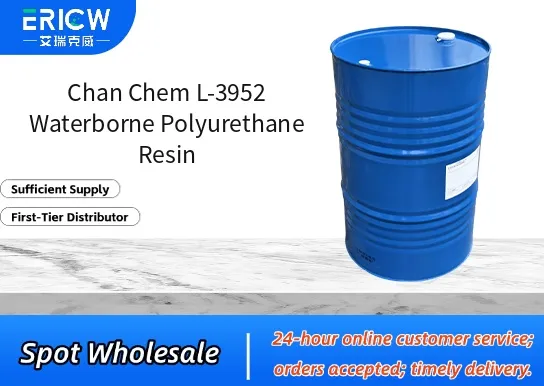
Low-VOC, environmentally compliant formulation meeting global regulatory standards for waterborne coatings.
Excellent film-forming capability with high gloss retention and superior clarity after drying.
Outstanding flexibility and abrasion resistance suitable for dynamic substrate applications.
Good compatibility with acrylics, cellulose derivatives, and common waterborne crosslinkers.
Stable viscosity profile over extended storage periods (≥12 months at 5–30°C).
High-performance leather finishing topcoats for footwear and upholstery.
Waterborne wood coatings requiring enhanced mar resistance and chemical durability.
Flexible plastic coatings for automotive interior trim and consumer electronics housings.
Textile coatings demanding breathability, wash-fastness, and soft hand feel.
Industrial maintenance coatings for metal substrates in low-emission environments.
| Chemical Type | Anionic aliphatic polyurethane dispersion |
| Product Form | Opaque white liquid |
| Appearance | Homogeneous milky dispersion, free of sediment or gel particles |
| Solids Content | 30.0 ± 1.0 wt% |
| pH Value | 7.8 – 8.4 |
| Viscosity (Brookfield, LVT #3, 60 rpm, 25°C) | 150 – 350 mPa·s |
| Particle Size (D50) | ≈ 45 nm |
| Minimum Film Formation Temperature (MFFT) | ≈ 12°C |
Q1: What are the primary application areas for Chan Chem L-3952?
A: Chan Chem L-3952 is widely used in high-performance waterborne coatings for flexible substrates, including textile finishing, synthetic leather topcoats, and soft-touch automotive interior coatings. Its excellent film-forming ability and low-temperature coalescence make it especially suitable for heat-sensitive materials.
Q2: How does L-3952 perform in terms of chemical resistance and durability?
A: L-3952 delivers robust resistance to abrasion, mild solvents, and repeated flexing due to its crosslinkable aliphatic polyurethane backbone. When properly cured—either thermally or via ambient moisture—it forms a tough, elastic film with good retention of gloss and tensile strength under mechanical stress.
Q3: Can L-3952 be blended with other waterborne polymers or additives?
A: Yes, L-3952 exhibits good compatibility with common waterborne acrylics, styrene-acrylic dispersions, and select cellulose derivatives. It also accepts standard water-based rheology modifiers, defoamers, and crosslinkers—though compatibility testing under intended formulation conditions is recommended prior to scale-up.
Q4: What is the typical solids content and viscosity range of L-3952?
A: L-3952 is supplied as a stable aqueous dispersion with solids content in the range of 30–35% by weight and a Brookfield viscosity (spindle #3, 20 rpm) typically between 500–2,000 cP at 25°C. Viscosity may vary slightly depending on batch and storage history.
Q5: Is L-3952 suitable for low-VOC or zero-NMP formulations?
A: Yes—L-3952 is inherently free of NMP, APEOs, and aromatic solvents, and contains no added VOCs beyond trace water-miscible co-solvents necessary for stability. It supports formulation strategies aligned with stringent environmental regulations for industrial and consumer-facing coating systems.
Contact With Us:
E-mail: wangxingqiang@ericwchem.com
Have a Questions? Call Us:
Add:
Building A1, Jiete Industrial Park, Huangpu District, Guangzhou City, Guangdong Province, China