English
 Español
 tiếng việt
 русский
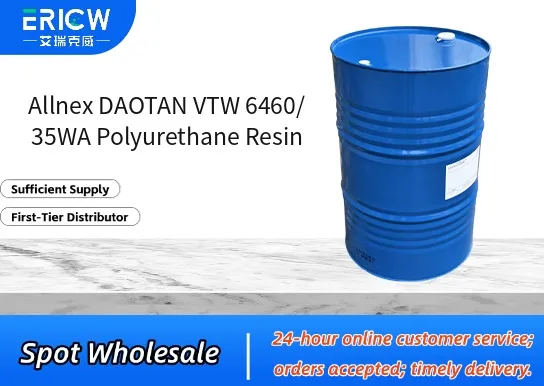
Waterborne aliphatic polyurethane dispersion offering excellent UV resistance and long-term gloss retention.
Low VOC formulation compliant with stringent global environmental regulations including EU REACH and US EPA standards.
Good hydrolytic stability and robust film formation at ambient cure conditions.
Compatible with common acrylic and polyester co-resins for hybrid coating systems.
Delivers balanced hardness, flexibility, and chemical resistance in final cured films.
High-performance waterborne wood coatings for furniture and interior joinery.
Architectural coatings requiring durable, low-emission finishes for interior walls and ceilings.
Plastic coatings for rigid substrates such as ABS and PVC in consumer electronics and automotive interiors.
Industrial maintenance coatings for metal components in mild-corrosion environments.
| Chemical Type | Aliphatic polyurethane dispersion |
| Product Form | Opaque white liquid |
| Appearance | Homogeneous aqueous dispersion |
| Solids Content (wt%) | 35 ± 1% |
| pH (at 25°C) | 7.5 – 8.5 |
| Viscosity (mPa·s, Brookfield LVT, Spindle #3, 20 rpm, 25°C) | 200 – 500 |
| Minimum Film Formation Temperature (MFFT) | ≥ 10°C |
| Primary Applications | Waterborne topcoats, clearcoats, and protective coatings |
Q1: What is the primary function of DAOTAN VTW 6460/35WA in waterborne polyurethane systems?
A: DAOTAN VTW 6460/35WA is a water-dispersible polyurethane resin designed primarily as a crosslinker or reactive modifier to enhance film hardness, chemical resistance, and mechanical durability in aqueous PU coatings and adhesives.
Q2: Is DAOTAN VTW 6460/35WA compatible with common waterborne acrylic dispersions and hybrid systems?
A: Yes — it exhibits good compatibility with a broad range of waterborne acrylics, vinyl acetate copolymers, and hybrid polymer dispersions, enabling formulation flexibility for high-performance topcoats and laminating adhesives.
Q3: How should DAOTAN VTW 6460/35WA be incorporated into formulations?
A: It is typically added during the final stage of dispersion mixing under mild agitation, at ambient temperature. Pre-dilution with deionized water may aid uniform incorporation, and pH adjustment (generally within 7.5–9.0) is recommended to maintain colloidal stability.
Q4: Does this resin require thermal curing, or can it achieve full performance at ambient conditions?
A: While ambient crosslinking occurs over time, optimal film properties—including solvent resistance and tensile strength—are achieved through moderate thermal curing (e.g., 80–120 °C for 10–30 minutes), depending on film thickness and substrate.
Contact With Us:
E-mail: wangxingqiang@ericwchem.com
Have a Questions? Call Us:
Add:
Building A1, Jiete Industrial Park, Huangpu District, Guangzhou City, Guangdong Province, China