English
 Español
 tiếng việt
 русский
Excellent abrasion resistance for demanding mechanical service life requirements.
Outstanding elasticity and recovery performance across a wide temperature range.
Good processability via injection molding and extrusion with low melt viscosity.
High transparency and excellent optical clarity in thin-walled parts.
Good resistance to oils, greases, and non-polar solvents.
Medical tubing and fluid handling components requiring biocompatibility support.
Consumer electronics protective cases and soft-touch overmolded grips.
Automotive interior trim, seals, and decorative accent elements.
Industrial rollers, conveyor belts, and wear-resistant elastomeric components.
Footwear midsoles and performance outsoles requiring energy return and flexibility.
| Chemical Type | Thermoplastic Polyurethane (TPU), Polyester-based |
| Product Form | Pellets |
| Appearance | Translucent, light amber granules |
| Primary Applications | Overmolding, extrusion, injection molding |
| Key Features | High elasticity, transparency, abrasion resistance |
| Benefits | Easy processing, recyclable, no plasticizers required |
| Processing Temperature Range | 180–220 °C (recommended melt temp) |
| Compliance | Meets ISO 10993-5 (cytotoxicity) for medical device contact |
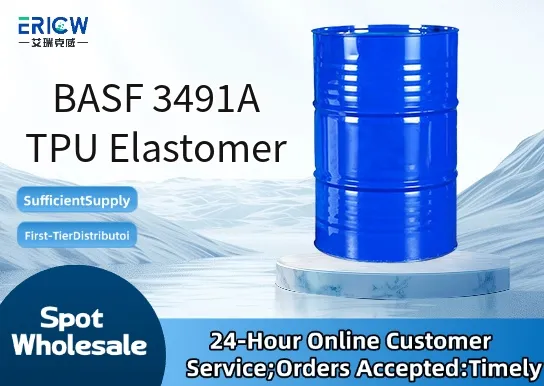
Q1: What is the primary application area for BASF 3491A TPU Elastomer?
A: BASF 3491A is a thermoplastic polyurethane elastomer specifically engineered for demanding extrusion and calendering applications, including high-performance automotive interior trims, flexible technical films, and durable surface laminates requiring excellent melt stability and surface aesthetics.
Q2: How does BASF 3491A differ from standard TPU grades in terms of processing behavior?
A: Compared to conventional TPUs, 3491A offers enhanced melt strength and reduced die swell during extrusion, enabling stable production of thin-gauge films and complex profiles. Its optimized rheology supports consistent output at elevated line speeds without sacrificing surface clarity or dimensional control.
Q3: Is BASF 3491A compatible with common polymer substrates used in lamination?
A: Yes — 3491A exhibits good adhesion to a range of thermoplastic substrates such as ABS, PC, and PP when processed under appropriate temperature and pressure conditions. Bond strength and interfacial compatibility may be further enhanced through surface pretreatment or the use of compatible tie layers.
Q4: Can BASF 3491A be used in applications requiring resistance to low-temperature flexibility?
A: Yes — as a polyester-based TPU, 3491A maintains good low-temperature performance and retains flexibility down to approximately −30 °C, making it suitable for outdoor and automotive applications exposed to cold ambient conditions.
Contact With Us:
E-mail: wangxingqiang@ericwchem.com
Have a Questions? Call Us:
Add:
Building A1, Jiete Industrial Park, Huangpu District, Guangzhou City, Guangdong Province, China