English
 Español
 tiếng việt
 русский
Excellent abrasion resistance for extended service life in demanding mechanical environments.
Outstanding low-temperature flexibility down to –40 °C without brittle failure.
Good oil and grease resistance, maintaining performance in contact with hydrocarbon-based fluids.
High transparency and clarity suitable for optical-grade applications requiring visual fidelity.
Easy processability via extrusion, injection molding, and calendering with minimal thermal degradation.
Transparent protective films for electronic displays and touch panels.
Flexible tubing for medical devices requiring biocompatibility and kink resistance.
High-clarity gaskets and seals in automotive lighting assemblies.
Soft-touch overmolding on consumer electronics housings and wearable device components.
Specialty wire and cable jacketing requiring UV stability and flame-retardant compatibility.
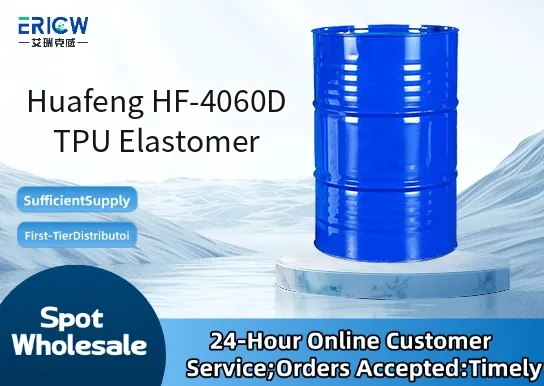
| Chemical Type | Aliphatic polyester-based thermoplastic polyurethane |
| Product Form | Pellets (free-flowing, uniform size) |
| Appearance | Translucent to clear, light yellowish tint |
| Density (g/cm³, 23 °C) | 1.18–1.20 |
| Melt Flow Index (g/10 min, 210 °C/2.16 kg) | 10–14 |
| Hardness (Shore A) | 60 ± 2 |
| Moisture Content (max.) | 0.05 wt% |
| Primary Applications | Transparent elastomeric components requiring clarity, flexibility, and chemical resilience |
Q1: What are the key processing advantages of HF-4060D compared to conventional TPU grades?
A: HF-4060D offers enhanced melt flow stability and reduced viscosity sensitivity during extrusion and injection molding, enabling smoother processing at lower shear rates and improved dimensional consistency in thin-walled or complex geometries.
Q2: Is HF-4060D suitable for applications requiring long-term hydrolytic stability?
A: Yes — HF-4060D is formulated with hydrolysis-resistant polyester-based chemistry, delivering significantly improved resistance to moisture-induced degradation under humid or elevated-temperature service conditions compared to standard polyester TPUs.
Q3: Can HF-4060D be co-extruded or overmolded with common engineering thermoplastics?
A: HF-4060D demonstrates good interfacial adhesion with polypropylene (PP), ABS, and certain PC/ABS blends when processed under optimized temperature and surface energy conditions; adhesion performance should be verified through application-specific bonding trials.
Q4: How does HF-4060D perform in low-temperature flexibility applications?
A: HF-4060D maintains excellent elastomeric resilience and impact resistance down to –25 °C, making it well-suited for outdoor, automotive, and wearable applications exposed to cold ambient environments.
Contact With Us:
E-mail: wangxingqiang@ericwchem.com
Have a Questions? Call Us:
Add:
Building A1, Jiete Industrial Park, Huangpu District, Guangzhou City, Guangdong Province, China