English
 Español
 tiếng việt
 русский
Excellent abrasion resistance for demanding dynamic applications.
High tensile strength and elongation at break, enabling robust mechanical performance.
Good low-temperature flexibility down to –30 °C.
Outstanding resilience and rebound properties for energy-efficient cyclic loading.
Compatible with standard thermoplastic processing methods including injection molding and extrusion.
Industrial rollers and conveyor belts requiring wear resistance and load-bearing capability.
Automotive interior trim components such as gear knobs and soft-touch surfaces.
Footwear midsoles and outsoles where cushioning and durability are critical.
Medical tubing and flexible connectors benefiting from biocompatibility and kink resistance.
Consumer electronics protective casings requiring impact absorption and surface aesthetics.
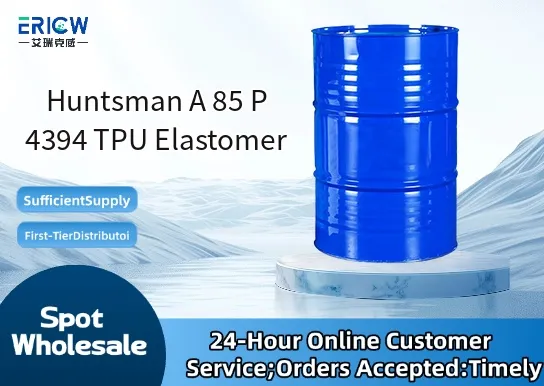
| Chemical Type | Thermoplastic Polyurethane (TPU) — Polyester-based |
| Product Form | Pellets |
| Appearance | Off-white to light beige, free-flowing granules |
| Hardness (Shore A) | 85 ± 2 |
| Density (g/cm³) | 1.18–1.22 |
| Melt Flow Index (230 °C / 2.16 kg) | 10–14 g/10 min |
| Key Features | High elasticity, excellent oil/grease resistance, good UV stability |
| Primary Applications | Dynamic elastomeric parts, flexible industrial components, durable consumer goods |
Q1: What is the primary functional role of A 85 P 4394 in thermoplastic polyurethane formulations?
A: A 85 P 4394 is a high-performance chain extender designed to enhance mechanical strength, thermal stability, and melt processability in aromatic TPU systems. It reacts selectively with isocyanate-terminated prepolymers to build molecular weight and improve elastomeric resilience.
Q2: Is A 85 P 4394 compatible with aliphatic TPU systems?
A: While optimized for aromatic TPU chemistries, A 85 P 4394 may be evaluated in aliphatic systems with careful consideration of reactivity balance and final property targets. Compatibility should be confirmed through small-scale reactive mixing trials and rheological assessment.
Q3: How does A 85 P 4394 compare to conventional diamine chain extenders in terms of processing safety?
A: As a solid, low-volatility amine-based extender, A 85 P 4394 offers improved handling safety versus liquid diamines—reducing inhalation risk and simplifying metering. Its controlled reactivity also supports broader processing windows during extrusion or injection molding.
Q4: What storage conditions are recommended to maintain product integrity?
A: Store in original sealed packaging under dry, cool conditions (below 30 °C) and protect from moisture and direct sunlight. Prolonged exposure to humidity may affect reactivity and handling characteristics due to potential surface hydrolysis.
Contact With Us:
E-mail: wangxingqiang@ericwchem.com
Have a Questions? Call Us:
Add:
Building A1, Jiete Industrial Park, Huangpu District, Guangzhou City, Guangdong Province, China