English
 Español
 tiếng việt
 русский
Excellent balance of elasticity and melt processability for injection molding and extrusion.
Superior soft-touch feel with high surface gloss and low coefficient of friction.
Good resistance to UV exposure, ozone, and aging under ambient conditions.
Compatible with polypropylene (PP) and polyethylene (PE) substrates for overmolding applications.
Halogen-free formulation meeting RoHS and REACH compliance requirements.
Automotive interior trim components including door panels, console covers, and gear shift boots.
Consumer electronics housings and soft-grip grips for power tools and household appliances.
Medical device overmolded grips and ergonomic handles requiring skin-safe contact.
Sealing rings and gaskets for industrial equipment requiring dynamic flexibility and compression set resistance.
Packaging closures and squeezable containers demanding recyclability and tactile performance.
| Chemical Type | Thermoplastic Elastomer (TPE) – Styrenic Block Copolymer (SBC) based |
| Product Form | Pellets |
| Appearance | Translucent off-white granules |
| Primary Applications | Overmolding, soft-touch finishing, flexible seals |
| Key Features | Easy processing, good adhesion to PP/PE, low odor |
| Benefits | Reduced cycle time vs. thermoset elastomers, 100% thermoplastic recyclability |
| Processing Method | Injection molding, extrusion, two-shot molding |
| Regulatory Compliance | RoHS 2015/863/EU, REACH SVHC-free, FDA-compliant for indirect food contact (per EU 10/2011) |
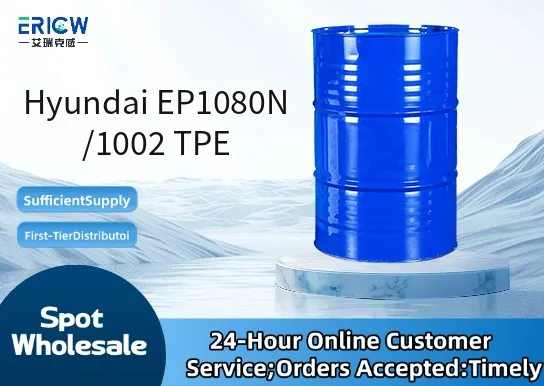
Q1: What is the primary function of Hyundai EP1080N/1002 TPE in polymer formulations?
A: Hyundai EP1080N/1002 TPE is a thermoplastic elastomer designed to enhance flexibility, impact resistance, and melt processability in polyolefin-based compounds—particularly in soft-touch overmolding, automotive interior parts, and consumer product housings.
Q2: Is EP1080N/1002 compatible with polypropylene (PP) and polyethylene (PE) matrices?
A: Yes—EP1080N/1002 is specifically formulated for compatibility with PP and PE homopolymers and copolymers. It exhibits good interfacial adhesion and dispersion without requiring additional compatibilizers in most standard processing conditions.
Q3: What processing methods are recommended for this TPE grade?
A: EP1080N/1002 is optimized for injection molding and extrusion. Its balanced melt viscosity supports stable flow in complex geometries and thin-walled parts, while maintaining low thermal degradation risk during typical cycle times.
Q4: Does this grade require drying before processing?
A: While EP1080N/1002 has low inherent moisture sensitivity compared to hygroscopic polymers, it is recommended to dry the material at 60–80 °C for 2–4 hours prior to high-precision or high-gloss applications to ensure optimal surface quality and mechanical consistency.
Q5: Can EP1080N/1002 be used in applications requiring regulatory compliance for food contact or skin contact?
A: EP1080N/1002 is not pre-certified for direct food contact or medical use. Customers intending such applications must conduct full formulation-level testing and validation per applicable regional requirements, as compliance depends on final part composition, processing history, and end-use conditions.
Contact With Us:
E-mail: wangxingqiang@ericwchem.com
Have a Questions? Call Us:
Add:
Building A1, Jiete Industrial Park, Huangpu District, Guangzhou City, Guangdong Province, China