English
 Español
 tiếng việt
 русский
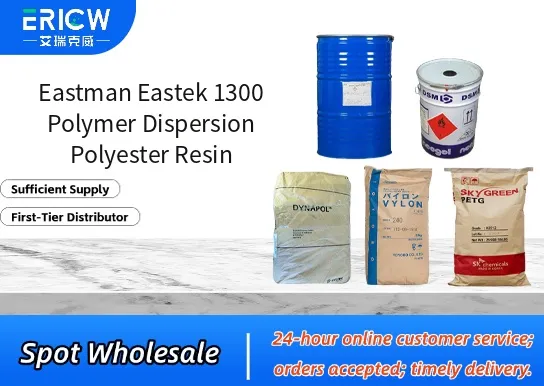
Water-based, non-ionic polyester dispersion offering excellent film-forming capability and low VOC content.
Provides superior flexibility and adhesion to diverse substrates including metals, plastics, and primed wood.
Exhibits good hydrolytic stability and storage stability at ambient temperatures for up to 12 months.
Enables formulation of high-gloss, clear coatings with balanced hardness and impact resistance.
Compatible with common crosslinkers (e.g., melamine, blocked isocyanates) for enhanced chemical and abrasion resistance.
Architectural and industrial maintenance coatings for metal substrates.
Waterborne coil coating topcoats requiring excellent formability and corrosion resistance.
Clear and pigmented finishes for furniture and cabinetry.
Basecoats in waterborne automotive refinish systems.
Functional coatings for plastic components in electronics and appliances.
| Chemical Type | Polyester resin dispersion |
| Product Form | White to off-white aqueous dispersion |
| Appearance | Opaque liquid, homogeneous without sedimentation |
| Solids Content (wt%) | 38–42% |
| pH | 7.5–8.5 |
| Viscosity (Brookfield, LVT, #3 spindle, 20 rpm, 25°C) | 100–300 mPa·s |
| Density (25°C) | 1.02–1.06 g/cm³ |
| Primary Applications | Waterborne industrial coatings, clearcoats, and functional topcoats |
Q1: What is the primary function of Eastman Eastek 1300 in coating and ink formulations?
A: Eastek 1300 functions as a film-forming polymer dispersion that enhances adhesion, gloss, and substrate wetting—particularly on challenging substrates such as polyolefins, PET, and metallized films. It serves as a binder or performance modifier in water-based systems where low-VOC, non-ionic stability, and good shear resistance are required.
Q2: Is Eastman Eastek 1300 compatible with other water-based resins and additives?
A: Yes, Eastek 1300 demonstrates broad compatibility with common water-based acrylics, vinyl acetate copolymers, and cellulose derivatives. It is also generally compatible with non-ionic surfactants, defoamers, and rheology modifiers—though compatibility should always be confirmed via small-scale formulation testing under intended processing conditions.
Q3: How does Eastek 1300 perform under heat or during thermal drying processes?
A: Eastek 1300 exhibits good thermal stability up to typical drying temperatures used in industrial coating lines (e.g., 80–120 °C). It coalesces effectively without significant degradation and supports rapid film formation. However, extended exposure above 130 °C may affect long-term film integrity depending on formulation and substrate.
Q4: Can Eastek 1300 be used in food-contact compliant coatings?
A: Eastek 1300 is designed for industrial and packaging applications where regulatory compliance is determined by the full formulation—not individual components. Formulators must evaluate the final system against applicable food-contact regulations, as Eastek 1300 itself is not pre-certified for direct food contact.
Q5: What are the recommended storage conditions for Eastek 1300?
A: Store Eastek 1300 in its original sealed container at temperatures between 5 °C and 30 °C. Avoid freezing and prolonged exposure to temperatures above 35 °C. Protect from direct sunlight and ensure adequate ventilation in storage areas to maintain optimal dispersion stability and shelf life.
Contact With Us:
E-mail: wangxingqiang@ericwchem.com
Have a Questions? Call Us:
Add:
Building A1, Jiete Industrial Park, Huangpu District, Guangzhou City, Guangdong Province, China