English
 Español
 tiếng việt
 русский
Excellent flexibility and impact resistance in cured epoxy systems.
Good chemical resistance, particularly to alkalis and solvents.
Low viscosity enables easy handling and improved compatibility with liquid epoxy resins.
Moderate pot life at ambient temperature, supporting practical application windows.
Low odor and reduced volatility compared to traditional amine curing agents.
Industrial protective coatings for steel structures and pipelines.
Marine antifouling and immersion-grade coating systems.
Concrete floor coatings requiring abrasion resistance and adhesion.
Electrical encapsulation and insulating varnishes for transformers and motors.
Adhesives and composite matrix resins in general-purpose bonding applications.
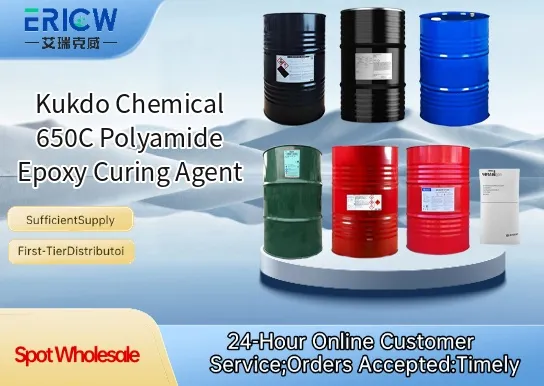
| Chemical Type | Polyamide adduct (modified aliphatic polyamine) |
| Product Form | Liquid |
| Appearance | Amber to light brown viscous liquid |
| Amine Value | 220–250 mg KOH/g |
| Viscosity (25°C) | 1,800–3,200 cP |
| Density (25°C) | 0.94–0.97 g/cm³ |
| Primary Applications | Epoxy resin curing for coatings, adhesives, and composites |
| Key Features | Flexibility, chemical resistance, low odor, ambient-cure capability |
Q1: What is the primary application profile of Kukdo 650C?
A: Kukdo 650C is a polyamide-based epoxy curing agent engineered for ambient- and low-temperature cure systems, commonly used in high-performance protective coatings, marine primers, industrial maintenance paints, and adhesive formulations where flexibility, corrosion resistance, and extended pot life are required.
Q2: How does 650C compare to conventional aliphatic polyamine curing agents?
A: Unlike fast-reacting aliphatic amines, 650C offers significantly improved handling safety, reduced volatility, and lower exotherm—making it suitable for thicker film applications and environments with limited ventilation. It also delivers superior flexibility and moisture tolerance compared to many standard amine adducts.
Q3: Is Kukdo 650C compatible with standard bisphenol-A and bisphenol-F epoxy resins?
A: Yes, 650C demonstrates broad compatibility with common liquid and solid epoxy resins, including DGEBA and DGEBF types. Optimal performance is typically achieved after thorough mixing and may benefit from mild thermal post-cure depending on the end-use requirements.
Q4: What are the recommended storage conditions for this product?
A: Store in original sealed containers under dry, cool conditions (below 30°C), away from direct sunlight and sources of moisture. Prolonged exposure to humidity or elevated temperatures may affect viscosity and reactivity over time.
Contact With Us:
E-mail: wangxingqiang@ericwchem.com
Have a Questions? Call Us:
Add:
Building A1, Jiete Industrial Park, Huangpu District, Guangzhou City, Guangdong Province, China