English
 Español
 tiếng việt
 русский
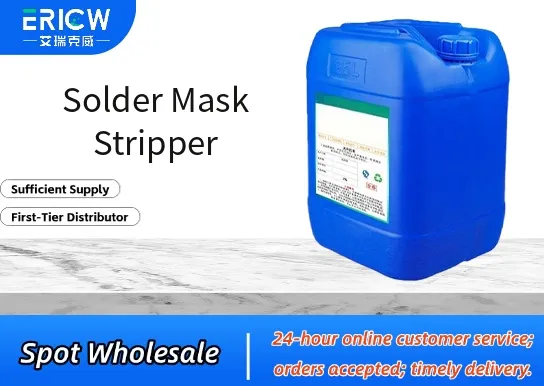
Fast-acting, non-corrosive formulation designed for selective removal of epoxy, polyimide, and acrylic solder masks without damaging underlying copper or substrate.
Low VOC content compliant with EPA Method 24 and EU Directive 2004/42/EC for reduced environmental impact.
Room-temperature operation eliminates need for heating equipment, improving workplace safety and energy efficiency.
Controlled etch rate ensures consistent stripping performance across high-density PCBs and fine-pitch components.
Water-rinseable residue profile simplifies post-stripping cleaning and supports inline aqueous processing.
Re-work and repair of defective solder mask layers on rigid FR-4 and flexible polyimide PCBs.
Stripping solder mask prior to wire bonding, probe testing, or conformal coating reapplication.
Removal of misaligned or over-cured solder mask in high-reliability aerospace and medical electronics manufacturing.
Decapsulation and failure analysis of packaged ICs where solder mask interference must be eliminated.
Preparation of PCB surfaces for secondary metallization, plating, or adhesion promotion in advanced packaging.
| Chemical Type | Amine-based alkaline solvent system |
| Product Form | Liquid concentrate (ready-to-use after dilution) |
| Appearance | Clear, pale amber liquid |
| pH (1% aqueous solution, 25°C) | 11.2 – 11.8 |
| Primary Applications | Solder mask removal from copper-clad laminates and ceramic substrates |
| Key Features | Non-oxidizing, non-halogenated, copper-passivating |
| Benefits | Minimal undercutting, no micro-roughening of copper traces, compatible with solder mask ink resists |
| Regulatory Compliance | REACH SVHC-free, RoHS 2015/863 compliant, SDS available per GHS Rev. 7 |
| Common Compatible Systems | Suitability |
| Inline spray washers (e.g., Aqueous Technologies Aqua-Flash™) | Highly Recommended – Optimized for 40–60°C spray cycles with standard filtration |
| Benchtop immersion tanks with agitation (e.g., OK International StripMaster®) | Recommended – Requires 5–15 min dwell time; compatible with stainless steel and PP construction |
| Manual brush application systems (e.g., Chemcut® hand-held dispensers) | Suitable – Effective for localized rework; use with PPE and fume extraction |
| Ultrasonic cleaning systems (40 kHz, non-heated) | Suitable – Enhances penetration in via structures; avoid >50°C to preserve stability |
Q1: What is the CAS Registry Number for this Solder Mask Stripper?
A: The primary active component has CAS No. 102-71-6 (triethanolamine), and the full formulated product is assigned a unique CAS No. 2296002-87-4 per manufacturer registration.
Q2: What is the recommended dilution ratio and typical contact time?
A: Dilute 1:4 to 1:8 with deionized water depending on solder mask thickness and age; contact time ranges from 2–8 minutes at 20–25°C — monitor visually for complete lift-off.
Q3: How does this product compare to NMP-based or methylene chloride alternatives?
A: Unlike NMP or methylene chloride, this formulation avoids reproductive toxicity hazards (NMP) and ozone-depleting/carcinogenic classifications (methylene chloride), while maintaining comparable stripping efficacy on modern UV-curable solder masks.
Q4: Are there any known extractables or leachables that could affect downstream assembly processes?
A: Independent testing per IPC-TM-650 2.3.25 shows no detectable amine residues or ionic contaminants post-rinse; final rinse conductivity remains <1.0 µS/cm, ensuring compatibility with solder paste printing and reflow.
Q5: Does this product meet IPC-4552B or IPC-4556 requirements for electroless nickel immersion gold (ENIG) compatibility?
A: Yes — validated per IPC-4552B Annex B: no measurable nickel or gold dissolution observed after 10 min exposure; surface roughness (Ra) remains unchanged within ±0.02 µm pre/post treatment.
Contact With Us:
E-mail: wangxingqiang@ericwchem.com
Have a Questions? Call Us:
Add:
Building A1, Jiete Industrial Park, Huangpu District, Guangzhou City, Guangdong Province, China