English
 Español
 tiếng việt
 русский
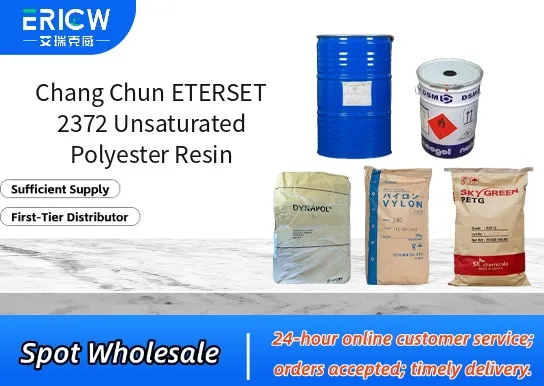
Excellent mechanical strength and dimensional stability after curing.
Good compatibility with standard MEKP initiators and low-viscosity reactive diluents.
Balanced reactivity for reliable gel time control in ambient and warm-mold processing.
High solids content ensures low volatile organic compound (VOC) emissions during handling and fabrication.
Superior weather resistance and UV stability when post-cured with appropriate additives.
Fiberglass-reinforced plastic (FRP) tanks and chemical storage vessels.
Marine deck components and boat hull laminates.
Industrial grating, ductwork, and corrosion-resistant structural profiles.
Automotive under-hood composite parts requiring thermal resilience.
Wind turbine blade root sections and nacelle enclosures.
| Chemical Type | Orthophthalic unsaturated polyester resin |
| Product Form | Liquid, ready-to-use |
| Appearance | Clear to pale yellow viscous liquid |
| Viscosity (25°C, mPa·s) | 450–650 |
| Solid Content (wt%) | ≈99.5 |
| Gel Time (with 1.0% MEKP, 25°C, min) | 18–24 |
| Acid Value (mg KOH/g) | 16–20 |
| Density (25°C, g/cm³) | 1.12–1.15 |
Q1: What are the key handling and storage requirements for ETERSET 2372?
A: ETERSET 2372 should be stored in tightly sealed containers under cool, dry, and well-ventilated conditions, away from direct sunlight, heat sources, and strong oxidizing agents. Prolonged exposure to elevated temperatures or moisture may affect viscosity and shelf life. Always follow standard industrial hygiene practices when handling.
Q2: Which initiators and accelerators are commonly used with this resin in ambient-cure applications?
A: ETERSET 2372 is typically cured using organic peroxides such as methyl ethyl ketone peroxide (MEKP) for room-temperature systems. Accelerators like cobalt naphthenate or cobalt octoate are frequently employed to adjust gel time and cure profile. Compatibility and dosage depend on formulation design and end-use performance targets.
Q3: How does ETERSET 2372 perform in reinforced composites, particularly with fiberglass?
A: This resin demonstrates good wet-out characteristics and interfacial adhesion with fiberglass reinforcements, supporting efficient impregnation and contributing to balanced mechanical properties in laminates. Its reactivity profile supports consistent crosslinking density, which helps achieve reliable dimensional stability and surface finish in hand lay-up and spray-up processes.
Q4: Can ETERSET 2372 be modified with styrene-reducing additives or alternative reactive diluents?
A: Yes, it can be formulated with low-VOC reactive diluents or styrene-reducing modifiers to meet evolving environmental and occupational health requirements. Any modification should be validated for compatibility, cure behavior, and final composite performance through laboratory-scale trials prior to full-scale implementation.
Contact With Us:
E-mail: wangxingqiang@ericwchem.com
Have a Questions? Call Us:
Add:
Building A1, Jiete Industrial Park, Huangpu District, Guangzhou City, Guangdong Province, China