English
 Español
 tiếng việt
 русский
Excellent clarity and gloss retention in transparent coatings and films.
Good compatibility with a wide range of resins, plasticizers, and pigments.
Low moisture absorption compared to cellulose acetate, enhancing dimensional stability.
Superior toughness, flexibility, and impact resistance at low temperatures.
Easy processability via solvent-based coating, extrusion, and injection molding techniques.
Automotive interior trim coatings for soft-touch and scratch-resistant finishes.
Protective overcoats for flexible packaging laminates and decorative films.
Binders and film formers in industrial wood and metal coatings.
Base resin for specialty inks, including gravure and flexographic printing inks.
Components in medical device housings requiring biocompatibility support and sterilization stability.
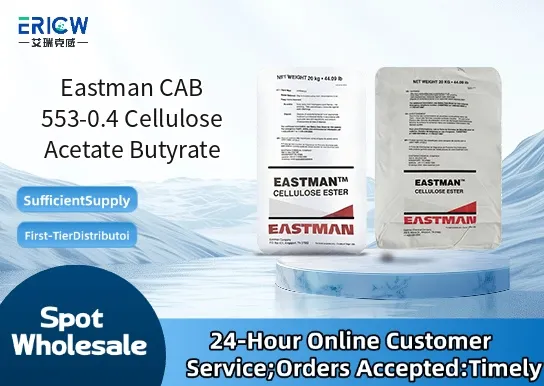
| Chemical Type | Cellulose acetate butyrate (CAB) |
| Product Form | White to off-white granular solid |
| Appearance | Free-flowing pellets or granules |
| Primary Applications | Coatings, inks, films, and thermoplastic compounds |
| Key Features | Low Tg (~10–12 °C), high butyryl content, medium molecular weight |
| Benefits | Enhanced flexibility, improved weatherability, and reduced brittleness |
| Solubility | Soluble in common organic solvents (e.g., ethyl acetate, MEK, toluene, acetone) |
| Regulatory Status | Complies with FDA 21 CFR §175.300 for indirect food contact coatings |
Contact With Us:
E-mail: wangxingqiang@ericwchem.com
Have a Questions? Call Us:
Add:
Building A1, Jiete Industrial Park, Huangpu District, Guangzhou City, Guangdong Province, China