English
 Español
 tiếng việt
 русский
Excellent abrasion resistance for demanding mechanical service conditions.
High elasticity and recovery performance after repeated deformation.
Good processability in injection molding and extrusion operations.
Outstanding oil, grease, and hydrocarbon resistance.
Consistent melt viscosity and thermal stability during processing.
Automotive interior trim components (e.g., instrument panel skins, door panels).
Industrial rollers and conveyor belts requiring wear resilience.
Technical hoses and fluid handling tubing in hydraulic systems.
Flexible couplings and vibration-damping mounts.
Protective overmolding for electronic enclosures and tool handles.
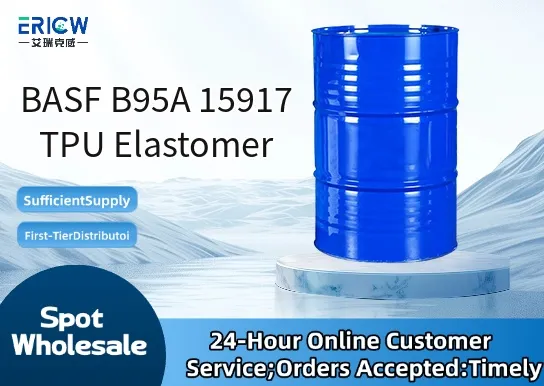
| Chemical Type | Thermoplastic Polyurethane (TPU), polyester-based |
| Product Form | Pellets |
| Appearance | Off-white to light beige, free-flowing granules |
| Primary Applications | Injection molding, extrusion, blow molding |
| Key Features | High tensile strength, low compression set, excellent tear resistance |
| Benefits | Enhanced part durability, reduced maintenance frequency, recyclable processing scrap |
| Processing Temperature Range | 180–220 °C (melt temperature) |
| Density | Approx. 1.20 g/cm³ (ISO 1183) |
Q1: What are the key processing methods suitable for BASF B95A 15917?
A: BASF B95A 15917 is a thermoplastic polyurethane elastomer designed for melt-processing techniques including injection molding, extrusion, and blow molding. Its balanced melt viscosity and thermal stability support consistent part formation across standard TPU processing equipment.
Q2: How does B95A 15917 compare to other TPU grades in terms of hardness and elasticity?
A: B95A 15917 is formulated as a medium-hardness TPU with Shore A hardness in the ~95A range, offering a favorable balance between flexibility and load-bearing capability. It delivers high resilience and low permanent set, making it especially suitable for dynamic applications requiring repeated flexing or impact absorption.
Q3: Is B95A 15917 compatible with common engineering plastics for co-processing or blending?
A: B95A 15917 exhibits good compatibility with several polar polymers such as PET, PC, and certain polyesters, enabling use in multi-material systems like overmolding or alloy formulations. Compatibility should be verified experimentally for specific end-use conditions, particularly under thermal or mechanical stress.
Q4: What are typical drying requirements prior to processing?
A: As with most hygroscopic TPUs, B95A 15917 requires thorough drying before processing to prevent surface defects and molecular degradation. Recommended drying conditions are typically 80–100 °C for 2–4 hours using dehumidifying dryers, with moisture content maintained below 0.05%.
Contact With Us:
E-mail: wangxingqiang@ericwchem.com
Have a Questions? Call Us:
Add:
Building A1, Jiete Industrial Park, Huangpu District, Guangzhou City, Guangdong Province, China