English
 Español
 tiếng việt
 русский
High thermal stability up to 600°C, suitable for high-temperature processing environments.
Excellent lightfastness and weather resistance, maintaining color integrity under prolonged UV exposure.
Non-toxic and heavy-metal-free formulation, compliant with global environmental and safety regulations including RoHS and REACH.
Superior dispersibility in aqueous and solvent-based systems, enabling uniform color distribution and reduced milling time.
Chemically inert and resistant to acids, alkalis, and common industrial solvents.
Ceramic glazes and frits for architectural tiles and tableware.
High-performance architectural coatings and facade paints.
Plastic coloration for outdoor applications including PVC profiles and polyolefin composites.
Colored concrete and precast cementitious products.
Specialty inks for industrial printing on heat-resistant substrates.
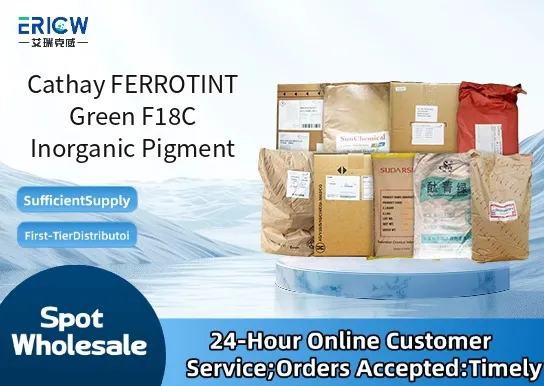
| Chemical Type | Complex iron-chromium oxide (Fe–Cr spinel) |
| Product Form | Fine dry powder |
| Appearance | Dark green granular powder |
| Primary Applications | Ceramics, coatings, plastics, construction materials |
| Key Features | Thermal stability, UV resistance, chemical inertness |
| Benefits | Non-toxic, consistent batch-to-batch color, low oil absorption |
| Density (g/cm³) | 4.8–5.2 |
| pH (10% aqueous suspension) | 6.5–7.5 |
Q1: What is the primary chemical composition of Cathay FERROTINT Green F18C?
A: Cathay FERROTINT Green F18C is a high-performance inorganic green pigment based on a stabilized iron-chromium spinel structure, offering excellent thermal and chemical stability without heavy-metal additives.
Q2: Is this pigment suitable for high-temperature polymer processing, such as polypropylene or engineering plastics?
A: Yes — F18C exhibits outstanding thermal stability and is routinely used in melt-processing applications up to 280 °C, including coloration of polyolefins, polyesters, and thermoplastic elastomers, with minimal risk of hue shift or degradation.
Q3: How does F18C compare to organic green pigments in terms of lightfastness and weather resistance?
A: As an inorganic spinel pigment, F18C delivers superior lightfastness, UV stability, and atmospheric resistance compared to most organic greens — making it preferred for outdoor applications and long-term color retention requirements.
Q4: Can F18C be used in food-contact plastics or toys?
A: F18C is formulated without regulated heavy metals such as lead, cadmium, or mercury, and is commonly selected for applications requiring compliance with general food-contact and toy safety expectations; however, final regulatory approval depends on the complete formulation and applicable jurisdictional requirements.
Q5: What is the typical dosage range when using F18C in plastic masterbatches?
A: Dosage is formulation-dependent, but F18C is generally effective at low concentrations — typically ranging from 0.1% to 2% by weight in final plastic articles, depending on desired opacity, shade intensity, and polymer matrix.
Contact With Us:
E-mail: wangxingqiang@ericwchem.com
Have a Questions? Call Us:
Add:
Building A1, Jiete Industrial Park, Huangpu District, Guangzhou City, Guangdong Province, China