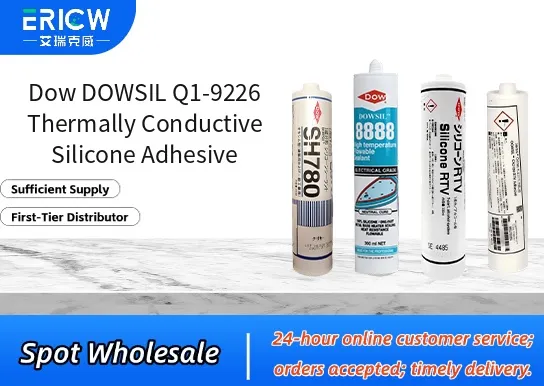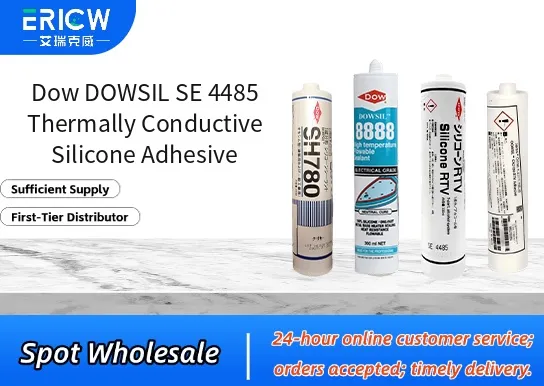
High thermal conductivity (1.5 W/m·K) for efficient heat dissipation in demanding electronic assemblies.
Low modulus silicone formulation provides excellent stress relief and long-term reliability under thermal cycling.
Room-temperature vulcanizing (RTV) system with rapid tack-free time and full cure within 24 hours at ambient conditions.
Excellent adhesion to common substrates including aluminum, copper, stainless steel, and FR-4 PCBs without primers.
UL 94 V-0 rated for flame resistance and compliant with RoHS and REACH regulatory requirements.
Thermal bonding of power electronics modules (e.g., IGBTs, MOSFETs) to heat sinks in EV inverters and industrial drives.
Die-attach and heat-spreader bonding in LED lighting systems requiring high lumen maintenance and thermal stability.
Attachment of sensors, battery management system (BMS) components, and DC-DC converters in automotive electronics.
Structural thermal interface in 5G base station RF power amplifiers and telecom infrastructure equipment.
| Chemical Type | Platinum-cured addition-cure silicone elastomer |
| Product Form | Paste (two-component, Part A + Part B) |
| Appearance | Gray, homogeneous paste |
| Primary Applications | Thermally conductive structural bonding and encapsulation |
| Key Features | RTV cure, low modulus, high thermal conductivity, electrical insulation |
| Benefits | Reduced thermal resistance, vibration damping, long-term aging stability, no corrosive by-products |
| Cure System | Addition cure (platinum catalyst); no condensation by-products |
| Storage Stability | 12 months at ≤25 °C (unopened containers) |
Q1: What are the primary application methods for this adhesive?
A: Dow DOWSIL SE 4485 is typically applied using dispensing equipment such as piston-driven or auger-based systems. It can also be manually applied for prototyping or low-volume assembly. Its thixotropic nature supports controlled bead formation and minimizes slump during cure.
Q2: How does this adhesive perform under thermal cycling conditions?
A: As a silicone-based thermally conductive adhesive, it exhibits excellent resilience to repeated thermal expansion and contraction. Its flexible cured matrix helps maintain bond integrity and thermal interface performance across wide temperature excursions commonly encountered in power electronics and LED lighting applications.
Q3: Is surface preparation required before applying this adhesive?
A: Yes — clean, dry, and contaminant-free surfaces are essential for optimal adhesion. Light abrasion and solvent wiping (e.g., with isopropyl alcohol) are recommended for most substrates. For low-surface-energy plastics or heavily oxidized metals, primer treatment may enhance long-term bond reliability.
Q4: Can this adhesive be used for structural bonding in addition to thermal management?
A: While it provides moderate mechanical strength after cure, Dow DOWSIL SE 4485 is primarily engineered for thermal interface and non-structural attachment. For load-bearing or high-stress assemblies, it should be supplemented with mechanical fastening or paired with a dedicated structural adhesive.
Q5: What is the typical cure profile, and can it be accelerated?
A: The adhesive cures at room temperature via moisture-cure chemistry, with full property development occurring over several days. Cure speed and depth can be accelerated with elevated temperature (e.g., 60–80 °C), though extended exposure above 100 °C is not recommended prior to full crosslinking.
Contact With Us:
E-mail: wangxingqiang@ericwchem.com
Have a Questions? Call Us:
Add:
Building A1, Jiete Industrial Park, Huangpu District, Guangzhou City, Guangdong Province, China
 English
 Español
 tiếng việt
 русский