English
 Español
 tiếng việt
 русский
High melt flow index for excellent processability in injection molding and extrusion.
Outstanding low-temperature flexibility and impact resistance down to –40 °C.
Superior compatibility with polypropylene (PP) and polyethylene (PE) for enhanced blend performance.
Excellent sealing and soft-touch properties ideal for flexible packaging and automotive interior applications.
Good UV stability and long-term weathering resistance without additional stabilizer packages.
Automotive interior trim, including door panels, instrument bezels, and soft-touch overlays.
Flexible packaging films requiring heat-sealability, toughness, and clarity.
Consumer goods components such as grips, seals, and elastomeric overmolds.
Medical tubing and device components where biocompatibility and flexibility are critical.
Industrial hoses and gaskets requiring chemical resistance and dynamic flex fatigue performance.
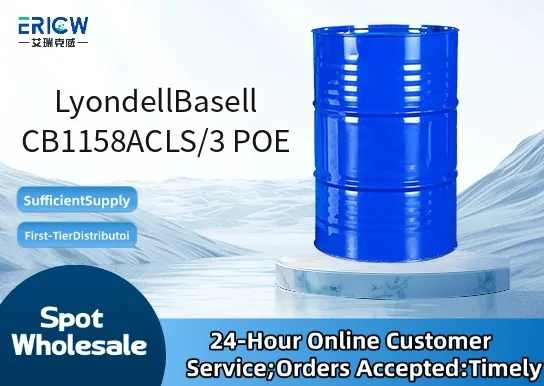
| Chemical Type | Polyolefin Elastomer (POE), ethylene-octene copolymer |
| Product Form | Pellets |
| Appearance | Off-white to light beige, free-flowing pellets |
| Melt Flow Rate (ASTM D1238, 190 °C/2.16 kg) | 12–16 g/10 min |
| Density (ASTM D792) | 0.868–0.872 g/cm³ |
| Hardness (Shore A, ASTM D2240) | 58–62 |
| Ultimate Elongation (ASTM D412) | ≥750 % |
| Primary Applications | PP/PE modification, soft-touch overmolding, flexible packaging |
Q1: What is the primary function of CB1158ACLS/3 POE in polymer formulations?
A: CB1158ACLS/3 POE is a polyolefin elastomer designed to enhance impact resistance, flexibility, and melt processability—particularly in polypropylene-based systems. It functions as a compatibilized impact modifier, improving toughness without significantly compromising stiffness or thermal stability.
Q2: Is CB1158ACLS/3 POE suitable for food-contact applications?
A: CB1158ACLS/3 POE is formulated for use in applications where regulatory compliance is required; however, final food-contact suitability depends on the complete formulation, processing conditions, and regional regulatory assessment. Customers should consult LyondellBasell’s regulatory documentation and perform full system-level evaluations before use in food-contact articles.
Q3: How does CB1158ACLS/3 POE differ from standard ethylene-propylene copolymers?
A: CB1158ACLS/3 POE features a controlled molecular architecture—including tailored crystallinity, narrow molecular weight distribution, and optimized comonomer incorporation—which delivers improved dispersion in PP matrices and more consistent mechanical performance compared to conventional EP copolymers.
Q4: What processing methods are recommended for CB1158ACLS/3 POE?
A: This grade is well-suited for conventional thermoplastic processing techniques including injection molding, extrusion, and blow molding. It exhibits good thermal stability and melt flow characteristics, enabling efficient processing across a range of equipment and temperature profiles commonly used for polyolefin compounding.
Contact With Us:
E-mail: wangxingqiang@ericwchem.com
Have a Questions? Call Us:
Add:
Building A1, Jiete Industrial Park, Huangpu District, Guangzhou City, Guangdong Province, China