English
 Español
 tiếng việt
 русский
Excellent melt processability for high-speed extrusion and injection molding.
Outstanding abrasion resistance and mechanical toughness at ambient and elevated temperatures.
Good low-temperature flexibility with a glass transition temperature (Tg) of approximately −35 °C.
Enhanced hydrolytic stability suitable for demanding humid or cyclic moisture environments.
Compatible with common plasticizers and polymer blends for formulation flexibility.
Automotive interior trim components including instrument panel skins and door panels.
High-performance wire and cable jacketing requiring flexibility and flame-retardant compatibility.
Medical tubing and fluid handling components meeting ISO 10993 biocompatibility requirements.
Durable consumer goods such as sportswear overlays, footwear uppers, and protective gear.
| Chemical Type | Aliphatic polyester-based thermoplastic polyurethane |
| Product Form | Pellets |
| Appearance | Off-white to light tan, free-flowing granules |
| Primary Applications | Extruded films, molded parts, coextrusions, and overmolding |
| Key Features | Melt flow index (230 °C/2.16 kg): 12–16 g/10 min |
| Benefits | Reduced cycle time, excellent surface finish, and low extractables |
| Processing Method | Injection molding, extrusion, blow molding |
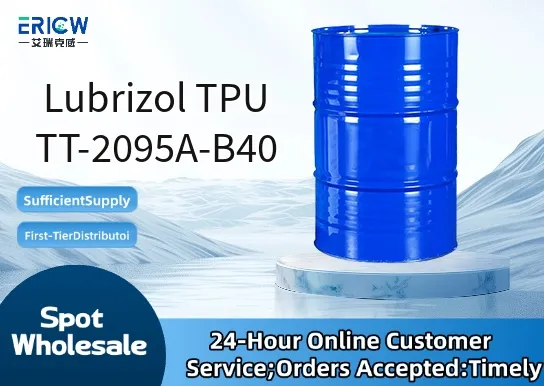
Q1: What is the primary function of Lubrizol TPU TT-2095A-B40 in thermoplastic polyurethane (TPU) formulations?
A: Lubrizol TPU TT-2095A-B40 is a specialized processing aid and surface modifier designed to improve melt flow, reduce extrusion pressure, and enhance surface gloss and clarity in TPU compounds—particularly during film, sheet, and profile extrusion.
Q2: Is TT-2095A-B40 compatible with all major TPU chemistries (e.g., polyester-, polyether-, and polycaprolactone-based TPUs)?
A: Yes, TT-2095A-B40 demonstrates broad compatibility across common TPU base resins. Performance optimization may vary depending on molecular weight, hardness, and polarity of the host TPU, so formulation-specific evaluation is recommended.
Q3: How should TT-2095A-B40 be incorporated into TPU processing?
A: It is typically introduced via dry blending with TPU pellets prior to extrusion or injection molding. Melt compounding is also effective, especially when uniform dispersion and consistent performance are critical for high-precision applications.
Q4: Does TT-2095A-B40 affect the mechanical properties of the final TPU product?
A: When used within the recommended dosage range, TT-2095A-B40 has minimal impact on tensile strength, elongation, or tear resistance. Some formulations may show slight reductions in modulus at higher loadings, but overall property balance remains favorable for most functional applications.
Contact With Us:
E-mail: wangxingqiang@ericwchem.com
Have a Questions? Call Us:
Add:
Building A1, Jiete Industrial Park, Huangpu District, Guangzhou City, Guangdong Province, China