English
 Español
 tiếng việt
 русский
Excellent melt processability for high-speed extrusion and injection molding.
Outstanding abrasion resistance and mechanical toughness at elevated temperatures.
Good hydrolytic stability, suitable for humid or outdoor service environments.
Low-temperature flexibility down to –40 °C without significant loss of elasticity.
Compatible with common polyurethane processing equipment and standard drying protocols.
Automotive interior trim components including instrument panel skins and door panels.
Flexible industrial hoses and pneumatic tubing requiring oil and ozone resistance.
High-durability technical films for protective lamination and packaging barriers.
3D printing filaments for functional prototypes requiring impact resilience and surface finish.
Medical device tubing and wearable sensor housings compliant with ISO 10993 pre-screening requirements.
| Chemical Type | Aliphatic polyester-based thermoplastic polyurethane (TPU) |
| Product Form | Pellets (free-flowing, uniform size) |
| Appearance | Off-white to light beige, translucent granules |
| Primary Applications | Extrusion, injection molding, calendering, film casting |
| Key Features | Melt flow index (MFI) ~10 g/10 min @ 220 °C/10 kg; Shore A hardness ~60 |
| Benefits | Reduced cycle times, minimal thermal degradation, consistent part quality |
| Processing Guidance | Dry before processing: 80–90 °C for ≥4 hours; melt temperature range: 190–230 °C |
| Regulatory Status | REACH compliant; RoHS 2011/65/EU conformant; no SVHCs above threshold |
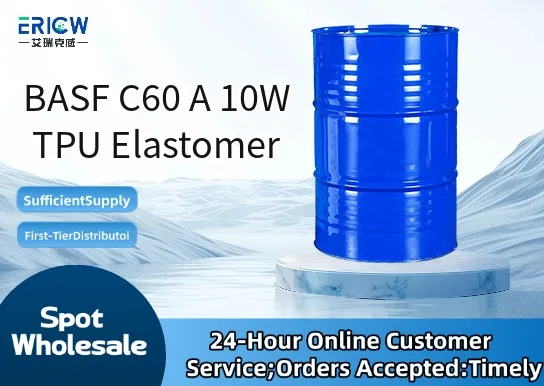
Q1: What is the primary function of BASF C60 A 10W in TPU formulations?
A: BASF C60 A 10W is a hydrolysis-stabilizing additive specifically designed to enhance the long-term durability of thermoplastic polyurethane (TPU) elastomers exposed to moisture and elevated temperatures. It functions by scavenging acidic degradation products formed during hydrolytic cleavage of urethane bonds.
Q2: Is C60 A 10W compatible with all major TPU chemistries (e.g., polyester-, polyether-, and polycaprolactone-based TPUs)?
A: Yes, C60 A 10W demonstrates broad compatibility across common TPU base resins, including polyester-, polyether-, and polycaprolactone-type systems. Its liquid form and low volatility support uniform dispersion during compounding without adversely affecting melt rheology or final mechanical properties.
Q3: How is C60 A 10W typically incorporated into TPU processing?
A: It is commonly added directly to the TPU melt during extrusion compounding or injection molding—either via side-feeding or inline metering. Due to its low viscosity and thermal stability up to typical TPU processing temperatures, it integrates efficiently without requiring pre-dilution or special handling.
Q4: Does C60 A 10W affect the color or clarity of transparent or light-colored TPU parts?
A: When used at recommended dosage levels, C60 A 10W has minimal impact on optical properties. It is formulated to be non-yellowing and does not introduce haze or discoloration in clear or pastel-grade TPUs under standard processing and aging conditions.
Contact With Us:
E-mail: wangxingqiang@ericwchem.com
Have a Questions? Call Us:
Add:
Building A1, Jiete Industrial Park, Huangpu District, Guangzhou City, Guangdong Province, China