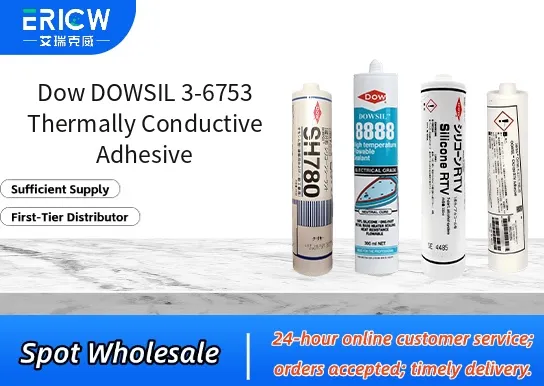
Features Of Dow DOWSIL 3-6753 Thermally Conductive Adhesive
High thermal conductivity (1.5 W/m·K) for efficient heat dissipation in demanding electronic assemblies.
Low modulus silicone formulation provides stress relief and accommodates thermal expansion mismatches.
Room-temperature cure with optional heat acceleration, enabling flexible manufacturing integration.
Excellent adhesion to common substrates including aluminum, copper, ceramics, and FR-4 PCBs.
UL 94 V-0 rated for flame resistance, supporting safety-compliant end-use designs.
Typical Applications Of Dow DOWSIL 3-6753 Thermally Conductive Adhesive
Thermal interface bonding of power modules and IGBTs in electric vehicle inverters.
Attachment of heat sinks to LED drivers and high-brightness LED packages.
Die attach and component mounting in aerospace and defense avionics systems.
Thermal management of 5G base station RF power amplifiers and mmWave modules.
Specifications Of Dow DOWSIL 3-6753 Thermally Conductive Adhesive
| Chemical Type | Filler-loaded addition-cure silicone elastomer |
| Product Form | Paste (thixotropic, dual-syringe or cartridge dispense) |
| Appearance | Gray, homogeneous paste |
| Primary Applications | Structural thermal interface material (TIM), die attach, heat sink bonding |
| Key Features | Thermally conductive, electrically insulating, low-stress, flame retardant |
| Benefits | Improved reliability under thermal cycling, simplified assembly vs. mechanical fasteners, RoHS compliant |
| Cure Mechanism | Platinum-catalyzed hydrosilylation (RT or elevated temperature) |
| Storage Stability | 12 months at ≤25 °C in unopened container |
Dow DOWSIL 3-6753 Thermally Conductive Adhesive – Frequently Asked Questions (FAQ)
Q1: What substrates does DOWSIL 3-6753 bond well to?
A: DOWSIL 3-6753 exhibits strong adhesion to a wide range of engineering substrates including aluminum, copper, stainless steel, nickel-plated surfaces, and common thermoplastics and thermosets used in electronics packaging—such as PPA, LCP, and epoxy mold compounds. Surface preparation (e.g., cleaning and optional plasma treatment) is recommended to optimize bond strength and long-term reliability.
Q2: How is DOWSIL 3-6753 typically cured, and what are the key processing considerations?
A: This adhesive is designed for thermal cure, typically requiring a two-stage profile: an initial low-temperature dwell (e.g., 80–100 °C) to allow flow and wetting, followed by a higher-temperature post-cure (e.g., 150–180 °C) to achieve full crosslinking and optimal thermal and mechanical performance. Cure time and temperature should be balanced against substrate thermal limits and production throughput requirements.
Q3: Does DOWSIL 3-6753 require mixing before use?
A: No—DOWSIL 3-6753 is a single-component, ready-to-use formulation. It does not require on-site mixing, eliminating concerns related to metering accuracy, pot life management, or stoichiometric imbalance. This simplifies manufacturing integration and supports consistent dispensing and process control.
Q4: How does this adhesive perform under thermal cycling and high-humidity conditions?
A: DOWSIL 3-6753 is formulated to maintain structural integrity and thermal interface performance across repeated thermal cycles (e.g., −40 °C to +125 °C) and prolonged exposure to high humidity environments. Its silicone-based chemistry provides inherent resistance to moisture ingress and hydrolytic degradation, supporting long-term reliability in demanding electronic assembly applications.
 English
 Español
 tiếng việt
 русский