English
 Español
 tiếng việt
 русский
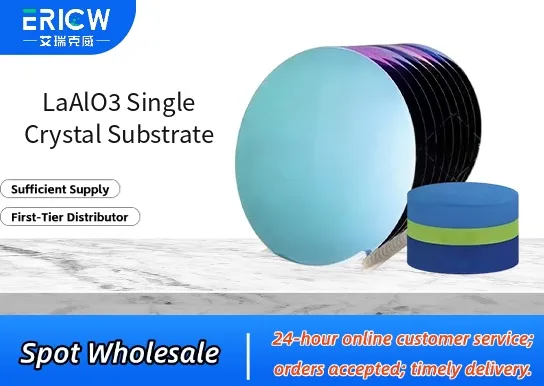
Highly stable perovskite crystal structure with excellent lattice matching to complex oxide thin films (e.g., LSMO, LCO, YBCO).
Low dielectric loss and high electrical resistivity (>10¹² Ω·cm at room temperature), ideal for insulating buffer layers.
Exceptional surface quality: RMS roughness < 0.2 nm over 5×5 µm AFM scan area after standard chemical-mechanical polishing (CMP).
Thermally robust with minimal thermal expansion mismatch to common functional oxides (CTE ≈ 10.5 × 10⁻⁶ K⁻¹, 300–800 K).
Optically transparent from UV to mid-infrared (≥80% transmission above 300 nm for 0.5 mm thickness).
Heteroepitaxial growth of high-temperature superconducting thin films (e.g., YBa₂Cu₃O₇₋δ) via pulsed laser deposition (PLD) or sputtering.
Platform for two-dimensional electron gas (2DEG) studies at LaAlO₃/SrTiO₃ interfaces.
Substrate for ferroelectric, multiferroic, and colossal magnetoresistive (CMR) oxide heterostructures.
Base material for integrated oxide electronics (OXIDE) and memristive device research.
Reference substrate in synchrotron-based X-ray diffraction (XRD) and resonant soft X-ray scattering (RSXS) experiments.
| Chemical Type | Lanthanum Aluminum Oxide (LaAlO₃), stoichiometric perovskite |
| Product Form | Single crystal wafer (polished both sides, orientation-specified) |
| Crystal Orientation | (001) ± 0.5°, (110) ± 0.5°, or (111) ± 0.5° (custom options available) |
| Standard Dimensions | 10 × 10 mm, 15 × 15 mm, or 2-inch diameter; thickness 0.5 mm or 1.0 mm |
| Surface Finish | Double-side polished (DSP), epi-ready; Ra < 0.3 nm |
| Melting Point | ~2100 °C (decomposition onset observed above 1950 °C in inert atmosphere) |
| Primary Applications | Oxide thin-film epitaxy, interface physics, quantum materials research |
| Regulatory Compliance | RoHS-compliant; no REACH SVHC substances above threshold; non-hazardous per GHS classification |
| Common Compatible Systems | Suitability |
| Pulsed Laser Deposition (PLD) systems (e.g., Newport, Coherent, Lambda Physik) | Highly Recommended – Optimized for high-vacuum, high-energy ablation with minimal substrate degradation |
| RF/DC Magnetron Sputtering platforms (e.g., Kurt J. Lesker, AJA International) | Highly Recommended – Stable under reactive oxygen plasma; enables stoichiometric oxide film growth |
| Molecular Beam Epitaxy (MBE) with oxide effusion cells (e.g., Riber, Veeco) | Recommended – Requires precise oxygen partial pressure control; compatible with in-situ RHEED monitoring |
| Atomic Layer Deposition (ALD) reactors (e.g., Beneq, Oxford Instruments) | Suitable – Supports low-temperature (<300 °C) nucleation of Al₂O₃ or HfO₂ interlayers; surface hydroxyls enable uniform seeding |
Q1: What is the CAS Registry Number for LaAlO₃?
A: The CAS Registry Number for lanthanum aluminum oxide (LaAlO₃) is 12003-20-6.
Q2: Is LaAlO₃ substrate suitable for aqueous or biological environments?
A: No — LaAlO₃ is chemically stable in dry air and high vacuum but slowly hydrolyzes in prolonged contact with humid or aqueous conditions; not recommended for direct immersion or cell culture applications.
Q3: How does LaAlO₃ compare to SrTiO₃ and STO substrates for oxide heterostructures?
A: LaAlO₃ offers higher bandgap (~5.6 eV vs. ~3.2 eV for STO), lower dielectric constant (εᵣ ≈ 24 vs. ≈ 300 for STO), and stronger polar discontinuity at interfaces — enabling sharper 2DEG confinement but requiring stricter growth temperature control.
Q4: Are there any known leaching or ion migration concerns when using LaAlO₃ in thin-film devices?
A: Under standard epitaxial growth and device operation conditions (≤700 °C, UHV/inert/O₂ ambient), LaAlO₃ shows negligible cation migration or interfacial interdiffusion; TEM-EDS confirms atomic-scale interface sharpness after post-growth annealing.
Q5: Does your LaAlO₃ substrate carry ISO 9001 or IATF 16949 certification?
A: Our LaAlO₃ single crystal substrates are manufactured under an ISO 9001:2015 certified quality management system; IATF 16949 does not apply as this is a research-grade material, not automotive production hardware.
Contact With Us:
E-mail: wangxingqiang@ericwchem.com
Have a Questions? Call Us:
Add:
Building A1, Jiete Industrial Park, Huangpu District, Guangzhou City, Guangdong Province, China