English
 Español
 tiếng việt
 русский
Excellent soft-touch feel with balanced elasticity and compression set resistance
Good processability via injection molding and extrusion without pre-drying
Enhanced adhesion to polypropylene (PP) and polyethylene (PE) substrates
Compliant with RoHS and REACH directives; free of phthalates, halogens, and heavy metals
Stable color retention and UV resistance for indoor and semi-outdoor applications
Automotive interior trim components (e.g., door armrests, center console overlays)
Consumer electronics housings and protective grips (e.g., power tools, kitchen appliances)
Medical device overmolding for non-sterile, touch-interface parts
Household appliance seals and ergonomic handles (e.g., vacuum cleaners, irons)
Packaging closures requiring soft-seal functionality and recyclability
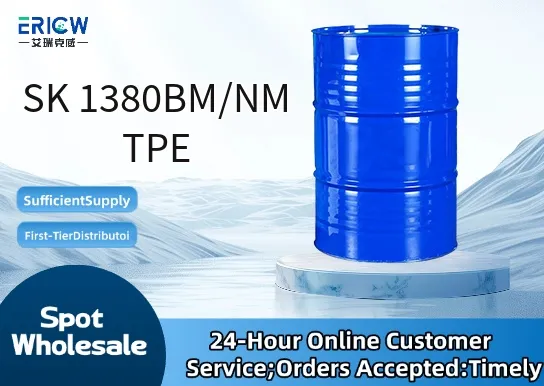
| Chemical Type | Thermoplastic Elastomer (TPE), SEBS-based |
| Product Form | Pellets |
| Appearance | Off-white to light beige, free-flowing granules |
| Primary Applications | Overmolding, soft-touch finishing, flexible sealing |
| Key Features | PP/PE adhesion, low odor, good thermal stability |
| Benefits | Reduced assembly steps, improved part aesthetics, recyclable design |
| Processing Temperature Range | 180–220 °C (melt temperature) |
| Density | 0.92–0.94 g/cm³ |
Q1: What is the primary functional role of SK 1380BM/NM TPE in polymer formulations?
A: SK 1380BM/NM TPE is a specialty thermoplastic elastomer designed primarily as a compatibilizer and impact modifier for polyolefin-based blends—especially in PP/EPDM or PP/SEBS systems—enhancing phase adhesion, toughness, and melt processability without compromising stiffness.
Q2: Is SK 1380BM/NM TPE suitable for applications requiring regulatory compliance for food contact or medical devices?
A: While SK 1380BM/NM TPE is formulated with non-toxic, high-purity components and is commonly used in food-contact-adjacent packaging and consumer product applications, formal regulatory clearance (e.g., FDA, EU Framework Regulation) must be verified case-by-case based on final formulation, processing conditions, and intended use—users are advised to consult technical support for application-specific compliance guidance.
Q3: How does SK 1380BM/NM TPE differ from standard SEBS or TPR grades in terms of processing behavior?
A: SK 1380BM/NM TPE features a tailored molecular architecture that provides lower melt viscosity and improved thermal stability during extrusion or injection molding compared to conventional SEBS-based TPRs—enabling smoother flow, reduced die swell, and better surface finish in thin-walled or complex geometries.
Q4: What are typical dosage recommendations when incorporating SK 1380BM/NM TPE into polypropylene-based compounds?
A: Dosage depends on the target performance balance (e.g., flexibility vs. rigidity), but it is typically used at low concentrations—generally ranging from 0.1% to 2% by weight—in PP homopolymer or copolymer matrices to achieve measurable improvements in impact resistance and ductility without significant softening.
Contact With Us:
E-mail: wangxingqiang@ericwchem.com
Have a Questions? Call Us:
Add:
Building A1, Jiete Industrial Park, Huangpu District, Guangzhou City, Guangdong Province, China