English
 Español
 tiếng việt
 русский
High adhesion strength to glass and polycarbonate substrates.
Excellent optical clarity and low haze for transparent safety laminates.
Superior melt flow and processability in extrusion and calendering operations.
Enhanced hydrolytic stability under humid and elevated temperature conditions.
Consistent batch-to-batch performance with tight molecular weight distribution.
Automotive laminated safety glass interlayers (windshields, sunroofs).
Architectural laminated glazing for facades, skylights, and blast-resistant windows.
Photovoltaic module encapsulation films (frontsheet bonding layer).
Acoustic interlayers for noise-reducing laminated glass solutions.
Specialty laminates requiring high optical fidelity and dimensional stability.
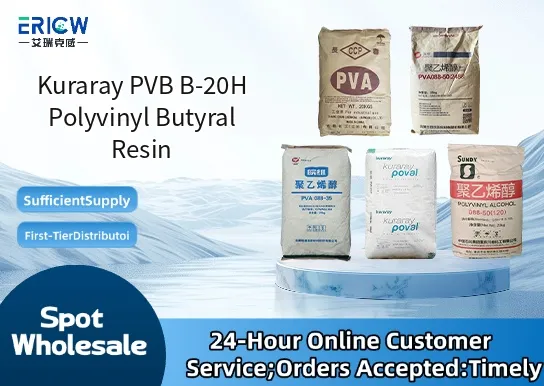
| Chemical Type | Polyvinyl butyral (PVB) copolymer |
| Product Form | Pellets |
| Appearance | Off-white to light yellow free-flowing pellets |
| Primary Applications | Safety glass interlayer, PV encapsulation, acoustic laminates |
| Key Features | High adhesion, excellent clarity, thermal stability, humidity resistance |
| Benefits | Improved lamination yield, reduced delamination risk, enhanced optical performance |
| Storage Conditions | Store in cool, dry place; protect from moisture and direct sunlight |
Q1: What is the primary functional role of Kuraray PVB B-20H in adhesive and coating formulations?
A: Kuraray PVB B-20H serves primarily as a film-forming binder and adhesion promoter, enhancing cohesion, flexibility, and interfacial bonding—especially on polar substrates such as glass, metals, and treated plastics.
Q2: How does B-20H differ from other PVB resins in terms of solubility and processing?
A: B-20H exhibits balanced solubility in common organic solvent blends (e.g., alcohols, ketones, esters), enabling stable solution preparation at ambient temperatures. Its moderate molecular weight supports good flow and leveling without excessive viscosity buildup during mixing or application.
Q3: Is Kuraray PVB B-20H suitable for use in safety glass interlayers?
A: No—B-20H is formulated for coatings, adhesives, and specialty inks, not structural laminated glass interlayers. For architectural or automotive safety glazing applications, Kuraray offers dedicated high-molecular-weight PVB grades with optimized clarity, toughness, and UV stability.
Q4: What are typical storage and handling recommendations for this resin?
A: Store in original sealed containers in a cool, dry place away from direct sunlight and strong oxidizers. Avoid prolonged exposure to moisture, as PVB resins may absorb ambient humidity over time—pre-sieving or mild drying before use is recommended if clumping is observed.
Contact With Us:
E-mail: wangxingqiang@ericwchem.com
Have a Questions? Call Us:
Add:
Building A1, Jiete Industrial Park, Huangpu District, Guangzhou City, Guangdong Province, China