English
 Español
 tiếng việt
 русский
High water solubility with rapid dissolution in cold and warm water.
Excellent film-forming capability yielding transparent, flexible, and strong films.
Good adhesion to polar substrates including paper, wood, and cellulose fibers.
Low residual acetyl content ensuring enhanced hydrophilicity and biodegradability.
Consistent batch-to-batch quality supported by ISO 9001-certified manufacturing.
Water-soluble packaging films for agrochemicals and detergent pods.
Binders in ceramic green bodies and refractory shaping processes.
Thickener and stabilizer in aqueous pigment dispersions for textile printing pastes.
Adhesive component in high-performance paper coatings and laminating systems.
Protective colloid in emulsion polymerization of vinyl acetate and acrylic monomers.
| Chemical Type | Polyvinyl alcohol (fully hydrolyzed) |
| Product Form | White granular powder |
| Appearance | Free-flowing, odorless white granules |
| Viscosity (4% aqueous solution at 20°C) | 4.0–5.0 mPa·s |
| Saponification Degree | ≥98.0 mol% |
| pH (5% aqueous solution) | 5.5–6.5 |
| Volatile Matter (wt%) | ≤5.0% |
| Ash Content (wt%) | ≤0.5% |
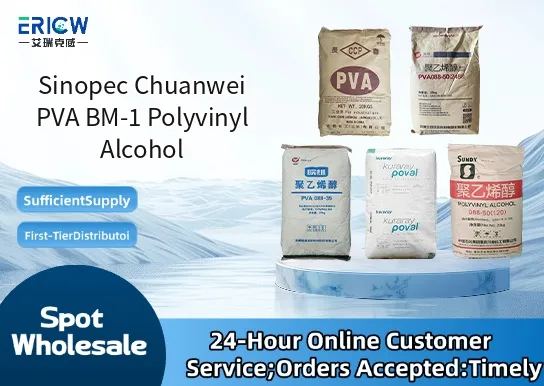
Q1: What is the primary functional role of Sinopec Chuanwei PVA BM-1 in water-based formulations?
A: PVA BM-1 serves primarily as a film-forming binder and rheology modifier in water-based systems, offering good adhesion, cohesive strength, and aqueous solubility. It enhances green strength in coatings, adhesives, and ceramic binders before thermal processing.
Q2: How does PVA BM-1 compare to other PVA grades in terms of alcoholysis degree and solubility behavior?
A: PVA BM-1 is a partially hydrolyzed grade, designed for balanced water solubility and film integrity. It dissolves readily in warm water without requiring extended heating or alkaline assistance, distinguishing it from fully hydrolyzed or highly crosslinkable PVAs that may exhibit slower dissolution or higher gel temperatures.
Q3: Is PVA BM-1 suitable for applications requiring thermal stability during drying or curing?
A: Yes — PVA BM-1 exhibits good thermal stability up to typical drying temperatures encountered in industrial coating and adhesive processing (e.g., below 120 °C). It forms robust, flexible films that retain integrity during moderate thermal treatment, though prolonged exposure above its softening range may affect mechanical performance.
Q4: Can PVA BM-1 be used in combination with other water-soluble polymers or additives?
A: Yes — PVA BM-1 demonstrates good compatibility with common water-soluble thickeners (e.g., HEC, CMC), dispersants, and certain acrylic emulsions. Compatibility should be verified in the final formulation, as interactions may influence viscosity development, film clarity, or drying kinetics.
Q5: What handling precautions are recommended for PVA BM-1 during storage and preparation?
A: Store in a cool, dry environment away from moisture and direct sunlight. When preparing solutions, gradually disperse the powder into cold or ambient water under gentle agitation to avoid lumping; then heat gently if needed to accelerate dissolution. Avoid high-shear mixing at initial dispersion to minimize foaming.
Contact With Us:
E-mail: wangxingqiang@ericwchem.com
Have a Questions? Call Us:
Add:
Building A1, Jiete Industrial Park, Huangpu District, Guangzhou City, Guangdong Province, China